


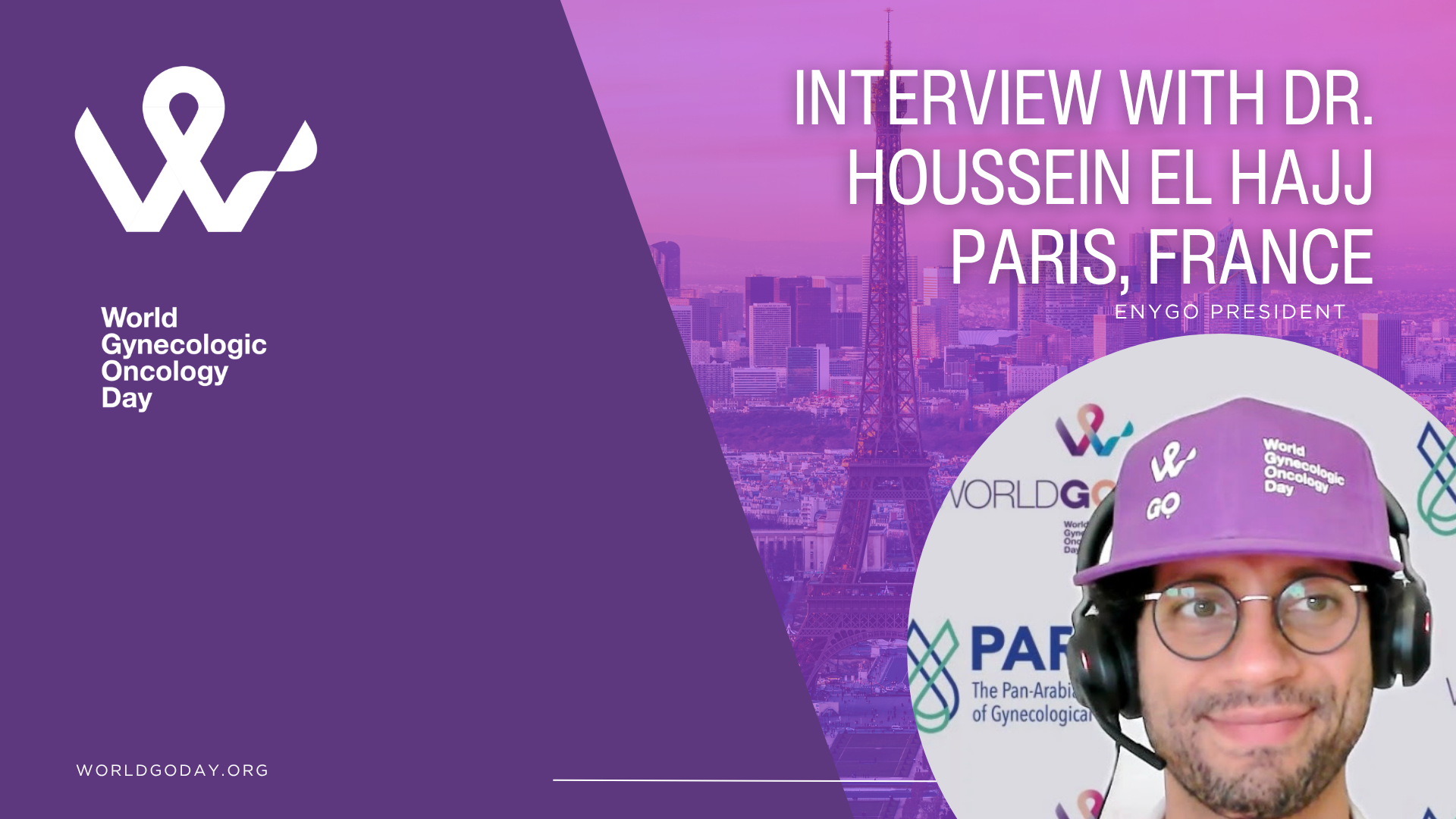
Dr. Houssein El Hajj is the ENYGO President, active member of the ESGO Prevention Committee, and works at Gustave Roussy Cancer Center in Paris (France). Apart from being a doctor, he is also a sportsman, marathon runner, and active supporter of cancer awareness.
Watch the video on YouTube(opens in new tab)
World Gynecologic Oncology Day: Today I have another live interview for you, this time with ENYGO President Dr. Houssein El Hajj. Hello. Nice hat.
Dr. Houssein El Hajj: Hey, I got the hat on. I'm here.
World Gynecologic Oncology Day: Perfect. So, Dr. Houssein, thank you so much for joining us today. I will just give you a short introduction for the people who are just joining us. This is Dr. Houssein El Hajj. He is a gyne oncologist at the Institute Gustave Roussy in Paris, which is one of the bigger cancer centers in Paris. He is also the president of ENYGO, the European Network of Young Gynaecological Oncologists — and by "young", it means in the early part of the career. So the people who are just starting to see patients and might be the very first people that a patient comes to when they are looking for a diagnosis for cervical, ovarian, endometrial, vaginal, or vulvar cancer. Dr. Houssein, could you please tell us something about yourself? You are involved in a lot of other activities as well, for example the International Journal of Gynecological Cancer.
Dr. Houssein El Hajj: Well, first of all, thank you very much for this invitation. I'm very happy to be here, and thank you for the introduction as well. Well, yes — ENYGO, as you said, is actually the network for young. So it starts with being a student, a resident, a fellow, and even an early career consultant. So it's a wide range of young people who take care of gynecological cancer patients. And at the same time, I also work with the journal alongside Professor Rayan Ribeiro. We are both associate editors responsible for the video article section in the journal. We've been there for a few years now and that's a really nice position.
World Gynecologic Oncology Day: That's wonderful. And you also mentioned to me before the call that you are the vice president of the French society for young doctors. Is that right?
Dr. Houssein El Hajj: Completely, yes. So this is the full Campus — that's the parallel with ENYGO but at the national level. So we also do research and educational activities on the French level.
World Gynecologic Oncology Day: And so, Dr. Houssein, this channel — World Gynecologic Oncology Day — is an awareness channel for the five gynecological cancers. What patients do you treat? Do you treat patients from all of the gynecological cancers?
Dr. Houssein El Hajj: Yes. We see patients from pre-invasive disease — so before having cancer, sometimes for prophylactic surgery in ovarian cancer or endometrial cancer, or even for pre-invasive disease in cervical cancer. And then we do see patients with local or advanced disease in ovarian, cervical, vaginal cancer, cancer of the uterus, and sarcoma. So all of the spectrum of gynecological cancers, we see them from pre-invasive to follow-up.
World Gynecologic Oncology Day: I love hearing all of the things that the gyne doctors can advise about, because I think one of the big concerns I've heard from people when they come to a doctor with a symptom is they're not sure if it's something weird or if they're bothering someone. It's really a comfort to know that there's a whole wide range of things and you've seen it all. So don't stress. Right?
Dr. Houssein El Hajj: Exactly. And it's always important to come and check, even if there's a doubt, instead of saying "hey, that's not important, I can just keep it." No — it's better to check and find nothing, rather than keep it and come back later with a bigger problem. So do not hesitate. Whenever you have any doubt, just check with your doctor. There are many less important things where people go check with their doctor, so don't worry about us — we are here for that.
World Gynecologic Oncology Day: I decided to ask Dr. Houssein to come on the channel today not only because he is the ENYGO president and super cool with this great hat, but because last month — was it in April? — he ran the Paris Marathon.
Dr. Houssein El Hajj: Yes, I did.
World Gynecologic Oncology Day: Which is already one amazing achievement. But two, he did it wearing a World Gynecologic Oncology Day t-shirt. So thank you. Tell us about that event.
Dr. Houssein El Hajj: Well, I think it's really important to raise awareness for gynecological cancers, and I think everyone of us can do even just a bit — but that will make people get to know more about what we do, about gynecological cancers. Because you are doing a great job with World GO Day, trying to remove the stigma, trying to get to everyone, to the people. And I think that's the most important thing — to get to the people, to everyone, even to people who don't have cancers, who might know someone, or just want to know about prevention. So it's really important to do that. And I thought that the marathon was the first step where I could do that — where you know, many people can run for a cause, and I ran for the cause of gynecological cancers. That's why I had the t-shirt of World GO Day and of Gustave Roussy, because that's the thing closest to my heart. And that's only the first achievement in a list to come. So I'm happy to have achieved the first one, and I would like to thank all of the people who supported this, because it takes quite a lot of commitment and help to run a marathon.
World Gynecologic Oncology Day: And you did the full marathon?
Dr. Houssein El Hajj: Yes.
World Gynecologic Oncology Day: Hats off to you. And you also mentioned something that I thought was cool — the t-shirt that you wore to run the race, you were then able to donate to a good cause.
Dr. Houssein El Hajj: Yes, exactly. So when you go there, you can donate t-shirts, and that was something I really wanted to do because this gives a message. The person who gets it will ask himself, "What's World GO Day?" and will go look it up and find out. And previously this year I also ran two other runs for cancer awareness — they were shorter, 10Ks. One is called Odysséa and the other one is called Cassiopéa. They're both also for cancer awareness in gynecology.
World Gynecologic Oncology Day: Okay. Well, do you mind if we share some photos of that after this?
Dr. Houssein El Hajj: I will send them to you.
World Gynecologic Oncology Day: And what about — because as I mentioned, ENYGO is the younger doctors, the doctors who are starting out and thinking about how they want to be known to their patients, building a reputation — I think you already have a reputation for being very patient-oriented. What advice would you give to other young gynecologists who are wanting to focus more on patient awareness and symptom awareness?
Dr. Houssein El Hajj: I think we all have the patient at the heart of what we do. This is why we did medicine in the first place, and this is why we chose what we're doing now. But then sometimes — and I think this is normal for everyone — throughout our career we try to achieve certain goals, certain exams, projects, certifications, which take a lot of our time, energy, and focus. It's important from time to time to just take one step back and remember why we do all of this. Because we're excited to do what we're doing and we give a lot of energy, but then we need to remember that we're dealing with a person in front of us. One of the things that struck me was a discussion I had with one of my patients when I went to her room to check on her after surgery. We were discussing about life and she said, "It's surprising, because we don't feel that there's a gap between us — it's as if we've known each other for a long time." And I told her that if we ever met outside the hospital, in a bar, in a restaurant, somewhere, and started talking, well, there wouldn't be any gap. It would just be a normal conversation. The fact that I am treating you doesn't mean there should be a gap. You're here for me to counsel you, to treat you — but otherwise we're just two simple human beings talking to each other. And I think this is the most important thing: to just remember that in front of us there's a person who has a life, a personal life, a professional life, and feelings and emotions.
World Gynecologic Oncology Day: That's beautifully said. Thank you so much. I will use that in a quote later, probably. Going back to awareness — it can feel really difficult to start doing something. Even wearing a hat like I wore this hat on the way here, I was thinking, "Okay, if somebody stops me, I can talk about World Gynecologic Oncology Day because I'm an expert." But for somebody who is just starting out, it might feel a bit strange to wear a t-shirt and run 26 miles. What advice would you give to your colleagues about being more extroverted in terms of awareness and getting involved in these campaigns?
Dr. Houssein El Hajj: That's a good question. Well, I think before talking about me, I would like to invite everyone to go check the website and see what everyone has done and put in place for World GO Day, because I find it amazing what people have done. There are so many different activities, different ideas. Everybody can come up with something that looks like them — they do not have to copy anyone else. They can just do what they think they can do. So I put this cap in my office next to my computer every day. It's there, and every time someone comes to the office, they see this cap next to my computer. Just by talking about what we do, by sharing what we do — that's the most important thing. And even with patients, when we see them and they are looking for information, we can just tell them, "Go check this website" or "Talk to this patient advocacy group." So we can start small, and small things build up. We just have to put one brick at a time.
World Gynecologic Oncology Day: I also liked what you've said about wearing the ENGAGe purple flower — which is the new initiative from ENGAGe to show that doctors are interested in patients' quality of life and that they listen. Could you talk about that a little?
Dr. Houssein El Hajj: I was very happy to discover this project, and I want to congratulate ENGAGe on doing this, because it's really important. In the past, when I started my training as a student, we used to talk about treating the patient. And now — this is what I try to tell the residents I work with, to the students, and even to the patients — we're not just talking about treating. That's still a main focus, but we're also talking about quality of life. Because we tend to think that once we treat a patient, everything is settled — but actually that's not it. When we start treatment, that's a new journey. And when we finish treatment, there's a whole new journey for the patient, where she has to rediscover herself, how to get back in control of her own body, of her life, her professional life, her personal life, and so on. So it's a long process, and quality of life should be at the center of what we do. This is also why there are a lot of studies on de-escalating treatment — we should focus on what's most important for the patient, and have the balance between the quality of treatment and the quality of life. And this is why I wear the flower. Me and two of my colleagues, we have this flower on our white coats every day. People ask us, "What is this flower about? Because it's beautiful." And when we tell them it's for quality of life, they're happy to know that people actually do care about the quality of life of patients.
World Gynecologic Oncology Day: And that is something you have studied quite a lot, actually. You mentioned before that you did a whole degree on biomedical ethics and how to bridge patient-doctor communication — that must have been one of the focuses?
Dr. Houssein El Hajj: Yes. My master's degree was on ethics and biomedical ethics, and my research project was on doctor-patient communication. It started from a simple observation — I noticed that some patients actually record their consultations. I was wondering why, and when I discussed it with them, I noticed that there's a big gap in communication. Sometimes it's on both sides. Patients sometimes don't ask because they're too afraid or feel they're not in a position to ask. And sometimes, without paying attention, subconsciously, if we think that one treatment is better for the patient, we tend to convince them to go in that direction instead of another — which is not ideal for shared decision-making. We need to work better on that. And sometimes, if we're not clear enough, patients interpret things. For example, if I take too long to say something, or if they look at our body language and we don't communicate — now when I'm reading a file and it takes time, I tell them, "Please, I'm going to take some time to read your file. If I don't say anything, it doesn't mean there's something to worry about." Because if you don't say that, they might think, "Maybe it's something severe and he doesn't know how to tell us." So it's really important to communicate about everything. And there's an anthropologist who sat down with doctors and looked at how they act with patients, and she wrote a book — a really interesting book. Her name is Sylvia Fainzang, and the book is on doctor-patient relations, truths and lies.
World Gynecologic Oncology Day: Can you say the title in French? I'm sure we'll have some French people watching.
Dr. Houssein El Hajj: Yes, the author is Sylvia Fainzang. And the idea is that when she looked at this, she noticed that sometimes it's not necessarily lies, but sometimes trying to change the truth, or focusing on one thing more than the other — on both sides. So sometimes the patient, because she's trying to look for something. I think there's a lot to work on in terms of communication, and it's also very important for the doctor to listen to the patient and give the patient the possibility to express themselves. We should keep in mind that it's not easy for a patient who just came to our office — within five or ten minutes we will examine them, and we are gynecologists, so it's not easy to go from "Hi, how are you, this is the first time we meet" to examining them, then announcing a cancer, and then a treatment plan. So it's really difficult. We need to establish this relationship and give them confidence, so they can feel they are being treated correctly as a human being, and afterwards feel comfortable talking about their problems, their feelings, and expressing themselves.
World Gynecologic Oncology Day: Do you recommend that patients record their consultations?
Dr. Houssein El Hajj: When they ask me, I say I don't mind. And it's always important for them to also be surrounded by others, because sometimes they forget. It's also very important to give patients drawings with information. For that, I would recommend everyone to go to the eAcademy and download the DDIs that are very well done, with drawings, explanations, and everything.
World Gynecologic Oncology Day: Let me say more about that for people who aren't sure what a DDI is. The Diagnosis Delivery Cards were designed by one of the ENGAGe members in Ireland. ENGAGe is the European Network of Gynecological Cancer Advocacy Groups, and World Gynecological Oncology Day is an ENGAGe project. These Diagnosis Delivery Cards are available for doctors to download on the ESGO eAcademy — I'll write it in the comments. You can search for the Diagnosis Delivery Cards — there's one for each of the cancers. And if patients are looking for them to take with them to the doctor, you can access those at the ENGAGe website, which is engage.esgo.org(opens in new tab).
Dr. Houssein El Hajj: Thank you.
World Gynecologic Oncology Day: So that also brings us to something else I wanted to ask you about — how to support cancer patients. The World Gynecologic Oncology Day theme this year, which we just announced at our kickoff meeting last month, is how to support cancer patients — moving from stigmatizing these gynecological cancers to supporting people who have them. What advice do you have for somebody who, for the first time ever, has encountered one of these cancers through a family member's diagnosis?
Dr. Houssein El Hajj: That's an important question. As a family member or caregiver — I think it's really important, first of all, to listen. There is a story that's actually pretty well known in Germany, for children — it's about Momo, who listens to others better than anyone else, sometimes without even talking. And I think Momo is someone who listens to everyone, sometimes without saying anything, just listens — and this lets people think and talk, and when they do, sometimes they find within themselves a lot of answers. So I think the most important thing is to listen to the patient. This is how we know how to help them, because we are not all the same. Some people would love to stay active, and others would not. Some would want to focus on certain things. So the most important thing is to get to know what they want and how they want to deal with it, and then bring them whatever we can and adapt — because there's no one rule that fits everyone.
World Gynecologic Oncology Day: So support starts, for you, with listening.
Dr. Houssein El Hajj: Yes, I think so. And being around. And also being around. Yes.
World Gynecologic Oncology Day: And for your colleagues — for doctors — what do you think support starts with? Also listening, or something else?
Dr. Houssein El Hajj: Well, I would say also listening, but also — do not hesitate to ask. Ask them how things are going. Ask them if they need psycho-oncology assistance or not, because sometimes that's also a taboo. Ask them if they want to see a sexologist or not. Ask questions that they might feel they cannot ask you, because for them the most important thing is to focus on treatment and everything else feels secondary — going back to physical activity, sports, "What should I do? Should I go back to work or not?" Do not hesitate. And sometimes it's also important to listen to them, because sometimes patients have personal problems or personal issues they want to deal with. Announcing a cancer can also be a problem for a couple, and this would affect the patient and the way she lives through her whole treatment period. So it's also important to see if she needs social support, if she needs psychological support. It's not only about the cancer we're treating — it's about this whole phase that we are accompanying the patient through in her life. We are actually going on a ride with her through a few years of her own life. So it's important to ask her, and if she says no, just do not be intrusive — but give them the space, give them the possibility to talk about things, and repeat it every time.
World Gynecologic Oncology Day: You mentioning asking questions and really drilling into what's behind what they've come to talk about reminds me of the World Ovarian Cancer Day theme this year. World Ovarian Cancer Day is a partner of ours, and we love them. They just had their big day on May 8th, with the hashtag "No Woman Left Behind." And I think one of the things, specifically for ovarian cancer, is that a lot of people either dismiss their own symptoms, or when they go to the doctor, they're told, "Well, it's probably nothing" or "Have you tried losing weight?"
Dr. Houssein El Hajj: Yes, exactly. That's the classic one, right?
World Gynecologic Oncology Day: So it really seems to be a part of what you're saying — that there needs to be not just the surface level, but going behind the question, finding out what they understand.
Dr. Houssein El Hajj: Exactly. And this is why we need to get to know the person in front of us. Because we're not treating cancer. We're not treating ovarian cancer. We're treating this person who has ovarian cancer. And this person has children or not, has a life, has a professional life, loves sports or not. Some patients' first question is, "When can I go back to running, to swimming, to tennis?" This is important for them, and this is part of how they deal with their disease. So it's really important to think about it, and to ask them how that has affected their personal life and if there's something you could do. And if they say no, then okay — and next time you can ask again.
World Gynecologic Oncology Day: You've made a lot of comments about seeing the person behind the diagnosis and really making sure you're treating the person. You also mentioned to me before we got on this call about some of the challenges that are taking place in France right now for patients. Even if you see the person behind it, what are some of the challenges beyond one doctor?
Dr. Houssein El Hajj: That's a really important question. With all the research that's been done for years around the whole world, there's one message that's really important for everyone: the centralization of care. And why? It's simple — when you treat patients in a specialized center with the right structure, and by that I mean the multidisciplinary tumor board, the access to clinical trials, the access to having on the same team a psycho-oncologist, nutritionists, physical activity specialists, psychologists, and so on — all of that within one structure — then, as the studies have shown, ovarian cancer patients treated in specialized centers have better survival than those treated in non-specialized centers. So it's really important — not only for quality of life, but for the survival of the patients, to be treated in specialized centers. And this is why it's a fight. It's a global fight. And in France, it's a fight too. The local authorities have put in place a project to have specific accredited specialized centers, and it's being implemented bit by bit. We're not there yet, but it's on the way. This is also the message of ESGO, the European Society of Gynecologic Oncology — the most important message is to have accredited centers and to have centralization of patient care within those centers, because those patients will have the best quality of care with an advantage in survival. And at the same time, patients can have access to clinical trials.
World Gynecologic Oncology Day: Which is really, really important too. And that's a whole other conversation we could have for another half hour, because giving patient voices into these processes so that doctors are making data-driven decisions with patient input — that is so important. Dr. Houssein, we have almost run out of time. Is there anything else you'd like to leave our patients with? A message perhaps for someone who is not sure if they should come to the doctor — they think they might have some symptoms, but it's pretty scary.
Dr. Houssein El Hajj: Go see your doctor. We're here for that. It's better to check. And even if it's nothing, that's better than not checking. So do not hesitate — we are here. Do not worry that you might take another patient's place. Everyone is important and everyone should have their own check-up, their own time. So do not hesitate. And to you, thank you very much. The time actually flew by — the 30 minutes went by really fast. And to everyone who can participate in World GO Day, or even if it's not for World GO Day, if you can participate in raising awareness for cancer, please do that.
World Gynecologic Oncology Day: That's right. So one more time before we sign off — this is Beth for World Gynecologic Oncology Day. World Gynecologic Oncology Day is a cancer awareness event on the 20th of September that focuses on the gynecological cancers: cervical cancer, ovarian cancer, endometrial cancer, vaginal cancer, vulvar cancer, and also some rare cancers that take place in the female reproductive system. And we have been speaking with the wonderful Dr. Houssein El Hajj, who is the president of ENYGO, the European Network of Young Gynecologic Oncologists. Thank you so much.
Dr. Houssein El Hajj: Thank you very much. Have a great day.
World Gynecologic Oncology Day: You too. Bye-bye.
Dr. Houssein El Hajj: Take care. Bye.