


From Patient to Campaigner: Breaking the Silence Around Gynecological Cancers
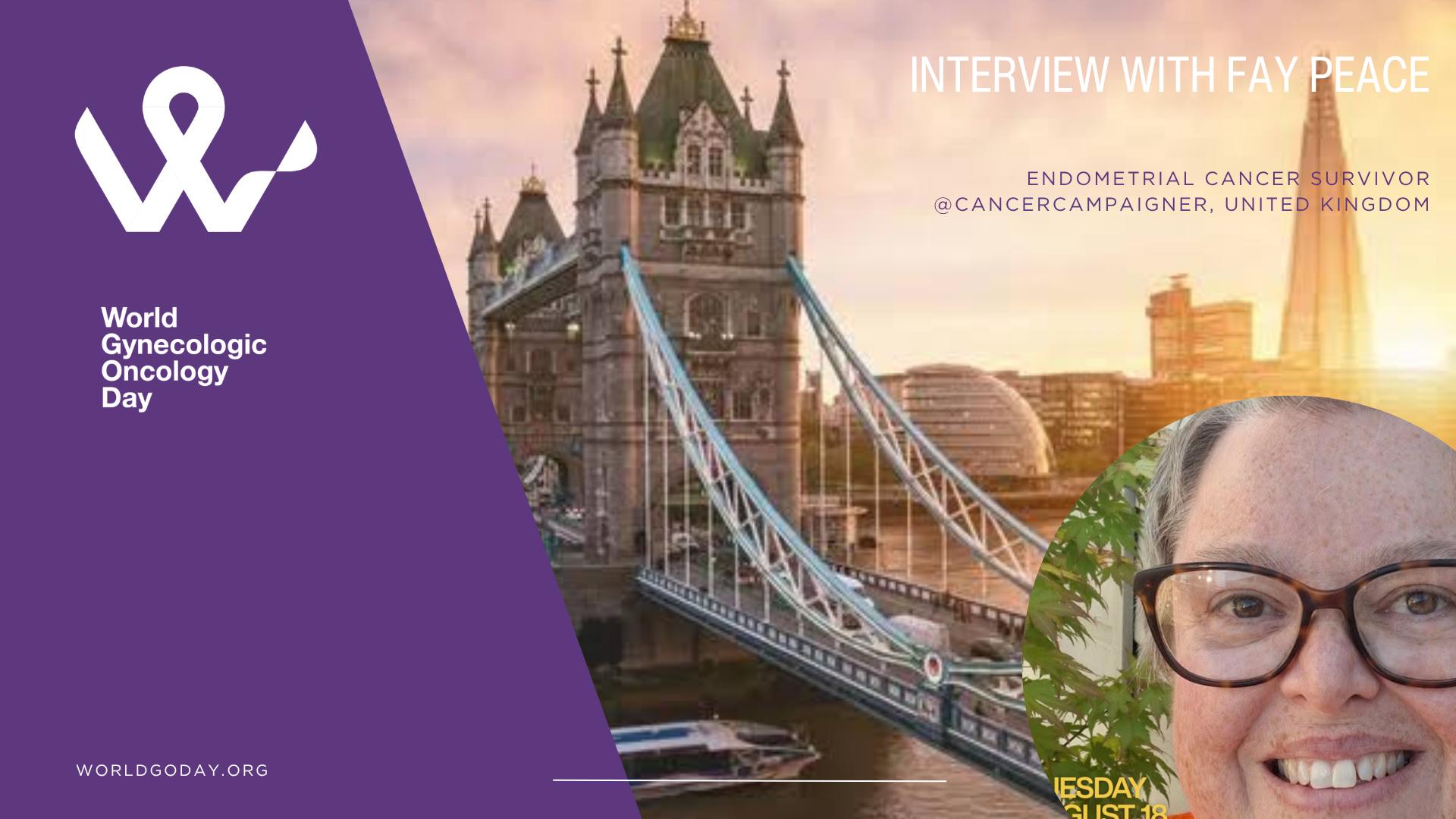
Fay Peace is an endometrial cancer survivor and @Cancercampaigner from Midlands in the UK.
Watch the video on YouTube(opens in new tab)
WORLD GYNECOLOGIC ONCOLOGY DAY: Hello and welcome. Today I have a very special guest for us, Fay Peace from Cancer Campaigners. Let me bring her on the call. Today we are going to have a conversation about Fay's work. There we go, we made it. Thank you so much.
I was just telling the people who are joining now that this is World Gynecologic Oncology Day Instagram. We are an awareness project from ESGO and ENGAGe, the European Network of Gynaecological Cancer Advocacy Groups. Our goal is to promote awareness about gynecological cancers. Here we have a shared goal with Fay Peace, my guest today, because Fay is the genius behind the Cancer Campaigner Instagram account, which has a unique and very interesting way of raising awareness about gynecological cancers and their symptoms. Fay, thank you so much for joining us today. Can you tell us something else about yourself?
FAY PEACE: Hi there! Thank you so much for having me on today. I live in the Midlands in the UK. I got diagnosed myself with womb cancer back in 2021 after going back and forth to my GP for almost two years. A really long time, being told that I had a UTI or that I was perimenopausal. When I finally got my diagnosis, I was at Stage 3. I went through a radical hysterectomy, chemotherapy, radiotherapy, and brachytherapy. So there were a lot of new things to face there. I had never heard of womb cancer before. Never. And I certainly didn't know what brachytherapy was. So it was a big learning curve.
WORLD GYNECOLOGIC ONCOLOGY DAY: Absolutely. How did you find the information when you needed to find out about womb cancer, endometrial cancer, or uterine cancer? How was that process?
FAY PEACE: We get a clinical nurse specialist in the UK when you get a diagnosis, and they informed me about Peaches Womb Cancer Trust, who are an amazing charity in the UK. I got a lot of information through them, and now I do some work for them through Peaches Patient Voices as a way of giving back. I also used websites like Macmillan and Cancer Research UK. So there are reputable places to go and get information from rather than just googling.
WORLD GYNECOLOGIC ONCOLOGY DAY: Or using AI, which is even scarier.
FAY PEACE: It really is, because it doesn't necessarily flag gynecological cancers up or register symptoms properly.
WORLD GYNECOLOGIC ONCOLOGY DAY: It sounds like you had good luck finding information after the diagnosis, but during that critical time before diagnosis when you had symptoms, you didn't know how to connect them to an actionable question for your doctor. Is that right?
FAY PEACE: Yes. Because I was getting different symptoms that were getting worse over time, I was putting in, "Could this be ovarian cancer?" or "Could this be cervical cancer?" because those were the two gynecological cancers I knew about, or even bladder cancer because of the affected areas. Because I didn't know about womb cancer, I wasn't searching for it. I think that was why I missed that it could potentially be womb cancer.
WORLD GYNECOLOGIC ONCOLOGY DAY: Right. Based in the UK, you were able to reach out to patient groups after diagnosis. How did you go from researching on your own to building thousands of Instagram followers?
FAY PEACE: When I finished my treatment, nobody had mentioned that you may go into a depression, but it felt like I'd fallen off a cliff. I'd gone from seeing medical professionals almost every day to suddenly, "Your treatment's finished, go off and enjoy your life." I went really low, to the point where I couldn't get myself out of bed.
At the time, there was an amazing lady called Dame Deborah James who had her own campaign. She had Stage 4 bowel cancer and passed away at the end of June 2022. Her campaign was to get bowel cancer symptoms onto toilet paper packaging, and she succeeded in getting it onto Andrex packaging and on the back of public toilet doors. I was lying in bed one day thinking, "If she can do it, I can do it. I need to turn this journey into something positive." On July 1st, 2022, I decided I was going to come up with a hashtag and start messaging different brands asking if they would consider putting gynecological cancer information onto their packaging.
WORLD GYNECOLOGIC ONCOLOGY DAY: What was the first thing you did then? You created the hashtag, which we need to mention is #CheckYouOut. Did you start reaching out to companies directly?
FAY PEACE: I started to create my own posts. Every time I saw a brand like Tampax or Always post, I'd comment underneath asking if they'd consider putting information about gynecological cancers onto their packaging. Generally, people ignored me, until the end of 2023. Bodyform started following me, and before I could even post, they messaged me saying, "We've seen all of your comments and posts, and because of that, we've decided to change the QR code on our packaging so that it goes directly to information about all five gynecological cancers."
They joined up with another charity called The Eve Appeal to create this page. It was phenomenal.
WORLD GYNECOLOGIC ONCOLOGY DAY: That is great! What other groups or brands have you been targeting?
FAY PEACE: When I first started, I thought anything "below the belt"—underwear, razors, period products. Then I decided to focus on period products. A company called Modibodi approached me wanting information to go in with their products. We designed a little insert that lists three symptoms of each gynecological cancer with a link to my page. That actually goes around the world with their underwear. Having that information right there might make someone think, "I need to go to my GP."
WORLD GYNECOLOGIC ONCOLOGY DAY: Getting those symptoms in front of people is so important. You mentioned that you've heard from lots of people who didn't even know it was possible to get vulvar or vaginal cancer until they actually had it.
FAY PEACE: Yes. That was one of the reasons why I decided to campaign to get all five gynecological cancers onto packaging. Most people have heard of ovarian or cervical cancer. If anyone is going to have a gynecological cancer mentioned on TV, it's going to be those.
WORLD GYNECOLOGIC ONCOLOGY DAY: Why do you think that is?
FAY PEACE: I think those cancers are less sexualized. Mentioning the word "vagina" or "vulva" on daytime TV is seen as tricky, but it shouldn't be. It should be absolutely normalized. Using the correct terminology when children are growing up is so important, because if you aren't using the right terms when they're young, they become embarrassed when they're older and might delay seeing their GP.
WORLD GYNECOLOGIC ONCOLOGY DAY: That brings us to the topic of stigma, which we've been working on with World Gynecologic Oncology Day. You do so much work on your page to normalize talking about these things. Did you have any qualms about recording yourself saying "vulva" or reciting a poem about a prod and a push at the first of the month?
FAY PEACE: To be honest, it wasn't the language. I used to be really shy and wouldn't do any public speaking until after my diagnosis, when I just thought, "Just do it." Doing the poem made a lot of people laugh. Cancer is a serious topic, but if I can have a laugh along the way and get the word out there, I'm all for that.
WORLD GYNECOLOGIC ONCOLOGY DAY: Speaking of stigma, sometimes the way risk factors for womb cancer or endometrial cancer are presented can be unintentionally stigmatizing. Can you talk about that?
FAY PEACE: When I got my diagnosis and looked into womb cancer risk factors, one of them was being overweight, and I immediately felt a lot of shame thinking it was my fault. I see a lot of people using the word "obesity." Womb cancer is actually related to higher levels of estrogen caused by carrying excess weight. Using the word "obesity" really shuts a lot of people down, especially if they've been fat-shamed by healthcare providers all their lives.
It also creates a dangerous assumption. You don't have to be overweight to get endometrial cancer. For example, people with Lynch syndrome have an increased risk of womb cancer, and many of them are very slim. So, framing it purely around weight is a barrier to awareness.
WORLD GYNECOLOGIC ONCOLOGY DAY: Absolutely. For womb cancer in particular, some symptoms are things women are just told to put up with, like lower back pain.
FAY PEACE: Yes. Women tend to get fobbed off, especially when it comes to pain. Also, womb cancer was historically seen as an older woman's cancer, with the main symptom being unusual postmenopausal bleeding. When you go to your GP, you need to be really clear about what your symptoms are, when they started, and how long they've been going on for. Going armed with that information helps your GP make a better assessment.
WORLD GYNECOLOGIC ONCOLOGY DAY: What do you think are some of the bigger concerns for gynecological cancer patients right now in the UK?
FAY PEACE: There is a total lack of a post-treatment care pathway in many counties across the UK. When you go for your three-monthly or six-monthly checkups, they perform an internal exam to check if the cancer has returned, but there's little support for managing long-term side effects. When someone has a stroke or a heart attack, there is a multidisciplinary post-treatment pathway with physios and nutritionists, but that generally doesn't exist for cancer survivors. My treatment stopped in June 2022, and I still have long-term side effects every day. Quality of life afterward is so important.
WORLD GYNECOLOGIC ONCOLOGY DAY: Last year was your first time joining World Gynecologic Oncology Day as a celebration partner, and this year you are hosting an in-person event. What do you have planned?
FAY PEACE: On September 20th, I've organized a walk at Arrow Valley Lake in Redditch, Worcestershire, at 9:30 AM. Anybody is welcome! I'm doing a brief talk about gynecological cancers before the walk. It's about getting fresh air, doing exercise, raising awareness, and fundraising for Peaches Womb Cancer Trust and The Eve Appeal. Afterwards, we're going to the countryside center cafe for tea and cake.
WORLD GYNECOLOGIC ONCOLOGY DAY: That sounds wonderful and embodies the spirit of World Gynecologic Oncology Day. What words of advice do you have for someone who has just received a gynecological cancer diagnosis?
FAY PEACE: Make sure you are going to reliable sources for information—organizations like Peaches Womb Cancer Trust, The Eve Appeal, Lady Garden Foundation, Ovacome, Target Ovarian Cancer, Macmillan, Cancer Research UK, or the NHS website. Please do not use AI to get your medical information.
WORLD GYNECOLOGIC ONCOLOGY DAY: Is there anything else you'd like to say to everyone watching?
FAY PEACE: A huge thank you to my followers! They are awesome. Cancer Campaigner is just me creating these posts, so I really appreciate all the support. Please check out the hashtag #CheckYouOut because nobody else is checking for you—you have to check yourself!
WORLD GYNECOLOGIC ONCOLOGY DAY: Thanks again, Fay, and thank you to everyone who joined us today! Have a great afternoon! Bye!