


Study Hard, But Be Human: Dr. Luisa Marcella Martins on Elevating Care and Awareness in Gynaecological Oncology
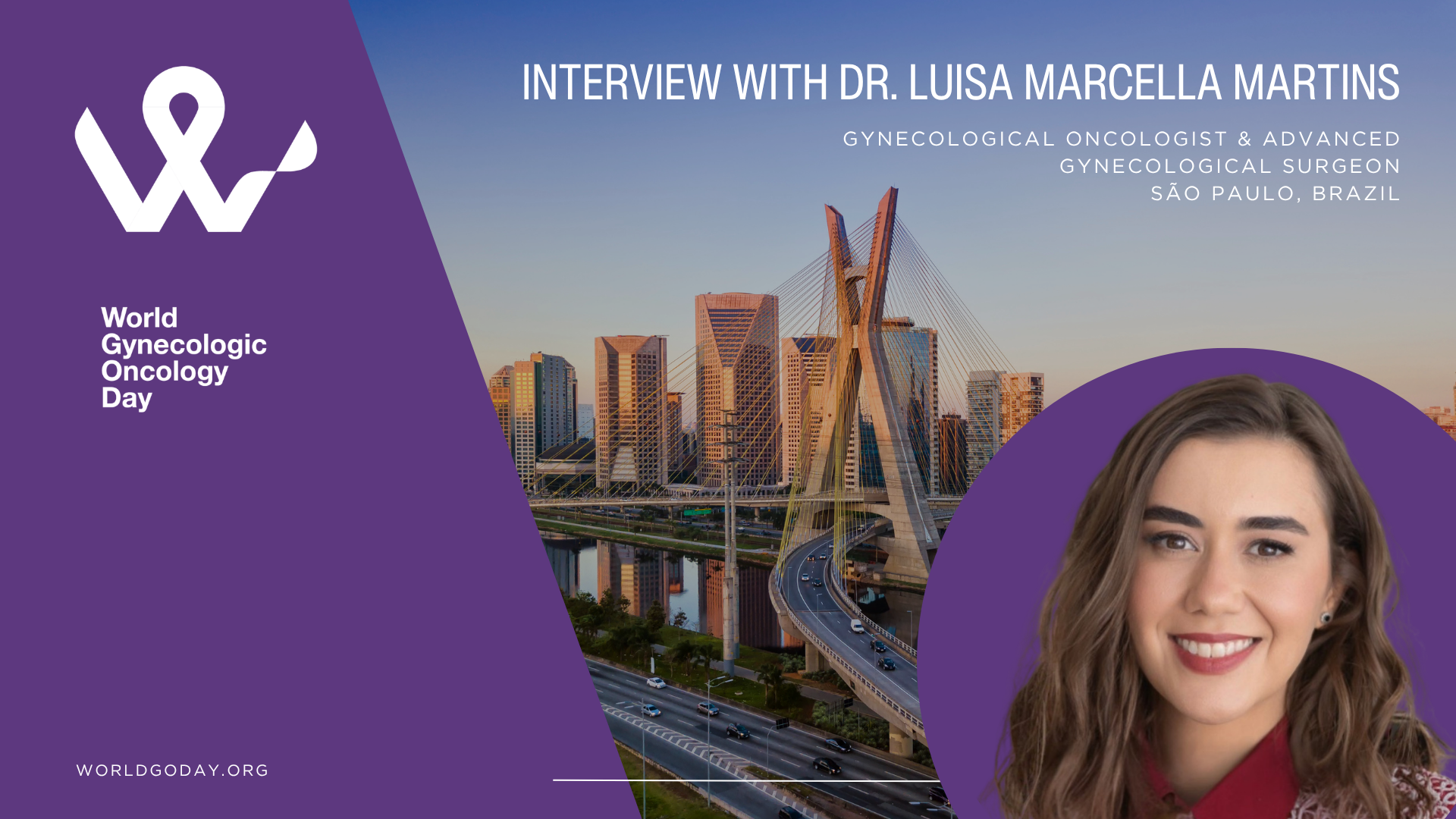
Dr. Luisa Martins is a gynecological oncologist & advanced gynecological surgeon in São Paulo, Brazil.
Watch the video on YouTube(opens in new tab)
Today we are going to have a wonderful conversation with Dr. Luisa Martins from Brazil. Hold on while I bring her on the call. I'm very excited to talk to her because we have never had someone from Brazil on this series so far to talk about the situation for gynaecological cancer patients in Brazil. Here she is. Hi Luísa! Thank you.
Dr. Luisa Marcela Martins is from São Paulo, Brazil. She is a gynaecologic surgeon and robotic surgeon. Dr. Luísa, could you please tell us something else about yourself?
LUISA MARTINS:Hi! Thank you for inviting me to be here. I am absolutely in love with gynaecological oncology. Right now I'm based in São Paulo and I mostly handle gynaecological cancers, but I also do benign surgical cases. That's what I really like doing.
WORLD GYNAECOLOGIC ONCOLOGY DAY: How did you get started in gynaecological oncology? What brought you to that path?
LUISA MARTINS:That's a funny story. I always knew I wanted to be a gynaecologist because my dad is a gynaecologist. When I started residency, the only thing I used to say I would not do was oncology because I thought, "I don't want to treat oncologic patients, that's so sad." But right in the first year of training, I got in touch with gynaecological oncology, learned how those patients are managed, and fell in love. I do not regret choosing that path at all.
WORLD GYNAECOLOGIC ONCOLOGY DAY: What is the difference between having regular surgery for a gynaecological cancer and having robotic surgery, which you specialize in?
LUISA MARTINS:Not all tumors can be operated on using a minimally invasive approach. The robotic platform is essentially an upgrade to the laparoscopic approach. It means less surgical trauma, faster recovery, and less scarring.
When you compare big open surgery to minimal incision surgery, it means a much less invasive approach, faster recovery, less blood loss, and quicker hospital discharge for the patient. In day-to-day care, it really optimizes patient outcomes. For example, trials have shown that we do not perform laparoscopic surgery for cervical cancer, and we respect that. But for endometrial cancer—where patients often have a higher BMI—the minimally invasive approach is safe and offers huge benefits.
WORLD GYNAECOLOGIC ONCOLOGY DAY: Brazil is such a large country with a large population. What are some of the unique challenges for gynaecological cancer care there?
LUISA MARTINS:Because Brazil is so vast, we face many regional contrasts. In São Paulo, we have a large health system with tertiary hospitals and specialized professionals, but that is not the reality nationwide. In remote locations, you do not have specialized surgeons or oncologists.
When patients in remote areas lack access to screening or doctors, they do not get diagnosed; if they do not get diagnosed, they do not get treatment. That is a major challenge.
We also see epidemiological differences across regions. In São Paulo, cervical cancer is the third most common cancer in women. But in the northern Amazonia region, cervical cancer is the second most common tumor in women, with twice the mortality rate. That contrast is largely due to sociodemographic factors.
WORLD GYNAECOLOGIC ONCOLOGY DAY: You are part of a project helping to combat cervical cancer in the Amazon region, right?
LUISA MARTINS:Yes, I volunteer with an NGO called Zoé that brings quality health services to remote regions, especially riverside communities that live far from big cities. It involves multiple specialties. My role is running gynaecological awareness campaigns, and we are working to implement screening tests to bring care to women who lack access. Cervical cancer can be eliminated, so we need to do this work!
WORLD GYNAECOLOGIC ONCOLOGY DAY: Brazil has introduced a new strategy regarding HPV screening and self-sampling. Could you tell us about that?
LUISA MARTINS:The Ministry of Health determined a transition from traditional Pap smears to HPV DNA testing within the public health system—which 70% of the population relies on.
Under this program, screening can be performed either by a health professional taking a cervical sample or through self-sampling. Self-sampling will expand how many women we can screen in a reliable, systematic way. Because of the size of the country, full implementation will take time, but it will be a game-changer, especially for women in rural areas.
WORLD GYNAECOLOGIC ONCOLOGY DAY: What is the situation in Brazil regarding stigma surrounding gynaecological cancers?
LUISA MARTINS:There is stigma associated with cancer in general—people still associate the word "cancer" with the end of life, which is something we are trying to change.
With gynaecological cancers associated with HPV, there is often a stigma that it is a sexually transmitted condition, leading to false assumptions about promiscuity. Because people don't talk about it openly, patients feel shame.
In older generations, there is also embarrassment about visiting a gynaecologist, or a fear of "disturbing" family members to get to a doctor for symptoms like vulvar lesions or postmenopausal bleeding. Newer generations are less ashamed to talk about intimate health, menstrual cycles, and body changes, which is a positive shift.
WORLD GYNAECOLOGIC ONCOLOGY DAY: You have built a strong online presence to share health information. How did you get started with digital advocacy?
LUISA MARTINS:I was very shy at first and worried about what colleagues or senior doctors might think. But online, many people without proper qualifications spread incorrect medical information. If you study hard and have expertise, it is your responsibility to share accurate, evidence-based information. Otherwise, misinformation fills that space.
When patients message me saying a video helped them understand a symptom and book an appointment, that positive feedback gives me the purpose to keep going.
WORLD GYNECOLOGIC ONCOLOGY DAY: What advice do you have for medical professionals who want to start sharing information online?
LUISA MARTINS:Be yourself and talk about what you are comfortable with. You don't need to jump on every TikTok trend or dance if that isn't your style. If you do something unnatural, you will give up after a few weeks. Know your theme, study it thoroughly, and bring genuine awareness.
WORLD GYNAECOLOGIC ONCOLOGY DAY: What advice would you give to young health professionals wanting to provide the best care for their patients?
LUISA MARTINS:Study hard, but be human. You need to connect with your patient and hear what they are saying beyond just seeing the disease. You have to put yourself in their shoes. When a woman receives a cancer diagnosis or prepares for major surgery, her world is turned upside down.
Clinicians should also provide detailed information. When you explain every step of the treatment to the patient, her family, and her support group, it becomes much easier to digest and navigate. Connecting patients with support groups is also an invaluable strategy.
WORLD GYNAECOLOGIC ONCOLOGY DAY: How can we continue to improve global awareness about gynaecological cancers?
LUISA MARTINS:The more we normalize talking about intimate symptoms—like postmenopausal bleeding or pain during intercourse—the more comfortable patients will feel bringing those concerns to us. If we don't bring up these topics, patients won't feel safe sharing what they are experiencing.
One thing I tell every single cancer patient is: "It is not your fault." So many patients carry guilt, thinking they did something wrong or failed to get vaccinated. Hearing face-to-face that it is not their fault is deeply healing.
WORLD GYNAECOLOGIC ONCOLOGY DAY: Do you have any final thoughts for patients?
LUISA MARTINS:For patients: even if you are referred to a service where you cannot choose your doctor, do your research, ask questions, and get your answers.
For doctors: be there for your patients as a human being, follow up, and use your voice to disseminate accurate information. The more professionals who share respectful, evidence-based information, the better off our patients will be.
WORLD GYNAECOLOGIC ONCOLOGY DAY: Thank you so much for your time today and for giving us insights into care in Brazil!
LUISA MARTINS:Thank you very much for having me! It is always a pleasure to talk about gynaecological cancers and support World Gynaecologic Oncology Day. Bye!