


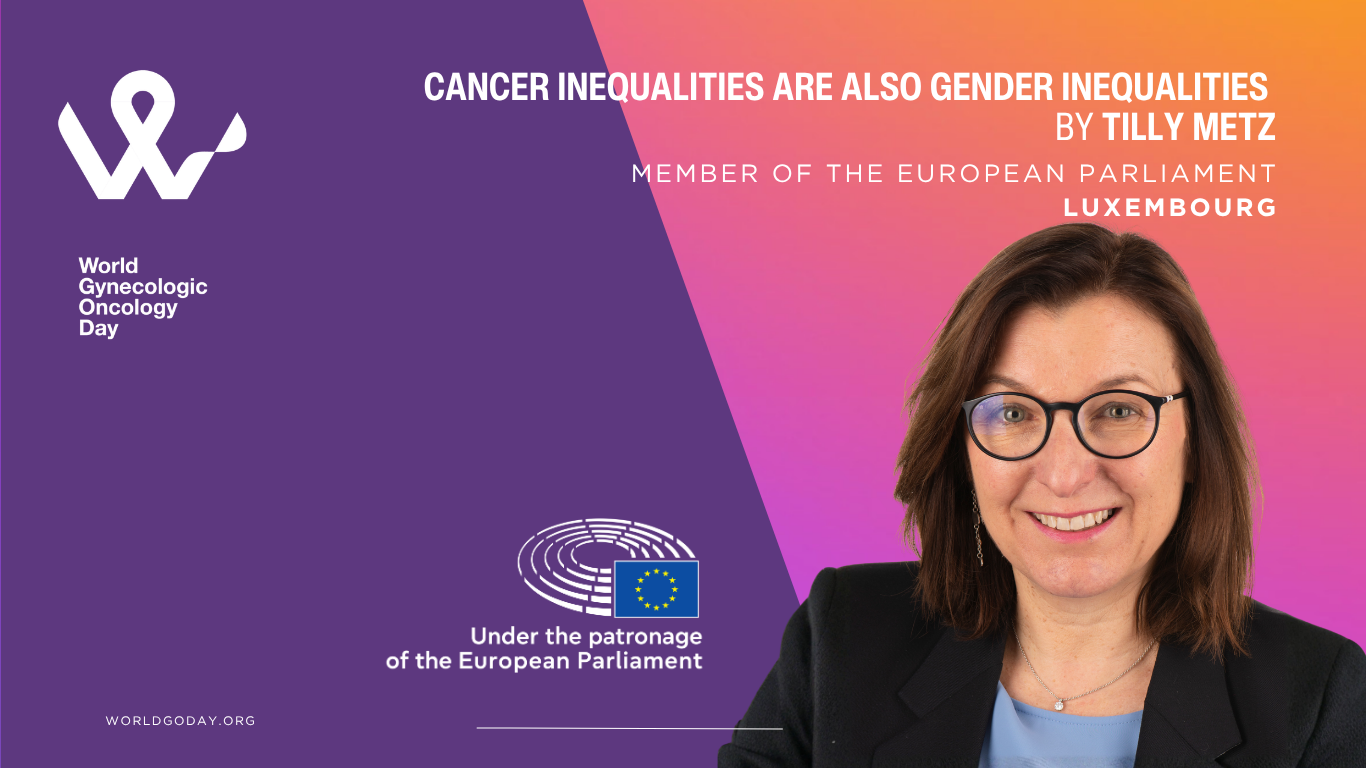
Cancer inequalities are also gender inequalities
By MEP Tilly Metz
World Gynecologic Oncology Day is the occasion to bring attention to cervical, ovarian, endometrial, vulval, and vaginal cancers that affect women. On top of awareness about these diseases, we must also speak about a harsh reality: in the EU today, two women with the exact same diagnosis can face completely different outcomes simply based on where they live. In 2022, more than 274,000 women in Europe were diagnosed with gynaecological cancer, and nearly 64,000 died in the EU alone.1
If we want to change those numbers, equal access to life-saving care must be at the very core of discussions. The way gynaecological cancers are prevented, diagnosed and treated is shaped by access to healthcare, by awareness, by socioeconomic circumstances and, systemically, by stigma and discrimination. So the real question today is simple: does every woman in Europe have the exact same chance to prevent these cancers, spot the warning signs, get diagnosed early, and access top-tier care? The evidence sadly says no.
Prevention remains unequal
In the EU, prevention and screenings do not reach women equally, depending on where they live, what they earn, and who they are.
Cervical cancer is one of the few types of cancer that can be prevented, thanks to the HPV vaccine and screening. Yet, screening participation still ranges from roughly 20 to 80%, depending on the Member States.2 This is way too far from the ambitious target set in Europe’s Beating Cancer Plan: 90% of eligible people should have been offered cancer screening (including for cervical cancer) by 2025.3
And the deepest divide isn't just between countries, but within them—where a woman’s income and education level often dictate whether she gets screened at all.
These disparities worsen when multiple forms of inequality overlap, creating systemic barriers for marginalised women. For instance, women with disabilities are significantly less likely to be screened.4 On average, socio-economically disadvantaged groups, including low-income earners, people with lower education, rural populations and people with a migration background, take less part in screenings compared to nationals almost everywhere this has been studied.5
Symptoms go unheard
Gynaecological cancers also tend to be diagnosed at an advanced stage because warning signs are not recognised. For example, nine in ten women diagnosed with ovarian cancer had multiple symptoms before the disease was found: bloating that does not go away, pain in the abdomen or the pelvis, needing to urinate more often, feeling full after a few mouthfuls.6 Those symptoms may be routinely read as irritable bowel syndrome, linked to stress, or caused by menopause or ageing.7 And since there is no validated population screening for ovarian cancer, early detection depends heavily healthcare professionals recognising symptoms and acting quickly. As a result, more than two thirds of cases are still found at an advanced stage.8
The rising incidence of endometrial cancer—now the most common gynaecological cancer in Europe—also exposes a critical systemic blind spot: ageism in healthcare. Because the disease primarily strikes post-menopausal women, it falls into a demographic whose health needs are routinely neglected. Women's health is often reduced to reproductive capability, abandoning attention as soon as fertility ends. Yet only around 5% of the health burden carried by women is attributable to sexual, reproductive and maternal health.9
Because medical education has historically treated the male body as the default, gender-specific warning signs are routinely overlooked, and women's pain or concerns are too often dismissed.
Awareness needs to be translated into concrete action
To end inequalities in health, we are not short of ideas: we need to collect sex- and gender-disaggregated data, guarantee the representation of women in clinical research, and healthcare professionals must be trained to recognise how gender affects symptoms and patient experiences. Today, around 72% of studies on drug trials still fail to provide sex- and gender-disaggregated data.10 Gender-sensitive training should be part of medical education, so that symptoms reported by women are recognised, investigated and acted upon earlier.
At EU level, there are encouraging signs of progress. The Gender Equality Strategy, presented by the European Commission in March,11 treats women’s health as a policy area in its own right for the first time,12 alongside a joint initiative with the World Health Organization on the quality and accessibility of women’s healthcare and a commitment that new clinical trials should reflect the diversity of the population. In September, days before World Gynecologic Oncology Day, the European Parliament will hopefully approve a report on gender inequalities in health,13 a step further towards (health) equality.
But we need to turn these commitments into concrete action.
World Gynecologic Oncology Day is an opportunity to demand faster political action for all women across Europe, no matter who they are or where they live, to give them the best chances to beat gynaecological cancer. It must mean transforming health systems so that they listen to women and are able to provide equal, timely and high-quality care throughout the EU.
Because cancer inequalities are also gender inequalities — and equality in health must mean equality in our chances to prevent, detect and survive cancer.
Footnotes & References
1 European Society of Gynaecological Oncology. Position statement on gynaecological cancers in Europe; 2025. Incidence covers Europe; mortality is the sum of EU-27 deaths in Table 1, sourced to the European Cancer Information System for 2022. Eurostat. Cancer screening statistics. Statistics Explained. Available from: https://ec.europa.eu/eurostat/statistics-explained/index.php?title=Cancer_screening_statistics(opens in new tab)
2 Eurostat. Cancer screening statistics. Statistics Explained. Available from: https://ec.europa.eu/eurostat/statistics-explained/index.php?title=Cancer_screening_statistics(opens in new tab)
3 Council Recommendation of 9 December 2022 on strengthening prevention through early detection, a new EU approach on cancer screening (OJ C 473, 13.12.2022, p. 1), https://eur-lex.europa.eu/legal-content/EN/TXT/?uri=CELEX%3A32022H1213%2801%29(opens in new tab), and recital K of the FEMM report on gender inequalities in health.
4 European Commission, Joint Research Centre. Uncovering inequalities: breast cancer screening in Europe. European Cancer Inequalities Registry factsheet; November 2023. https://cancer-inequalities.jrc.ec.europa.eu/sites/default/files/ECIR-inequalities-factsheet-breast-cancer-screening-Nov2023.pdf(opens in new tab)
5 European Commission, OECD. EU Country Cancer Profiles 2025: synthesis report. European Cancer Inequalities Registry; February 2025. https://cancer-inequalities.jrc.ec.europa.eu/sites/default/files/docs/ccp2025/ec-oecd-synthesis-report-250124-1422.pdf(opens in new tab)
6 The World Ovarian Cancer Coalition's Every Woman Study, published as Reid F et al., International Journal of Gynecological Cancer, Vol. 31, 2021, pp. 238-244, https://doi.org/10.1136/ijgc-2019-000983(opens in new tab), open PDF at https://worldovariancancercoalition.org/wp-content/uploads/2025/04/EWS-2018-_IJGC.pdf(opens in new tab)
7 A survey of 1,531 women in 44 countries diagnosed between 2013 and February 2018. The Coalition's own summary is that nine in ten experienced multiple symptoms before diagnosis, irrespective of stage or type: https://worldovariancancercoalition.org/ovarian-cancer/symptoms-risks(opens in new tab)
8 ESGO position statement, section 2.2.1, which states that ovarian cancer continues to be diagnosed at advanced stages in more than two thirds of cases because no validated population-based screening method exists. Section 2.1 describes it as the most lethal gynaecological cancer for that reason.
9 World Economic Forum, McKinsey Health Institute. Closing the women's health gap: a $1 trillion opportunity to improve lives and economies; January 2024. https://www3.weforum.org/docs/WEF_Closing_the_Women%E2%80%99s_Health_Gap_2024.pdf(opens in new tab)
10 Recital D of the FEMM report, citing the Care4Everybody study 'Mind the Gap: Costs, consequences and correction of sex and gender inequality in medicine' (2023), https://www.care4everybody.org/wp-content/uploads/2023/12/Mind-the-Gap-Costs-Consequences-and-Correction-of-Gender-Inequality-in-Medicine.pdf(opens in new tab).
11 The Commission adopted the Gender Equality Strategy 2026-2030 on 5 March 2026: https://commission.europa.eu/document/1f5fa936-9fba-4435-93f5-32fa220bac82_en(opens in new tab).
12 Press release: https://ec.europa.eu/commission/presscorner/detail/en/qanda_26_527(opens in new tab) and the announcement text at https://www.eeas.europa.eu/delegations/chile/commission-presents-new-gender-equality-strategy-2026-2030-more-equal-cohesive-and-successful-europe_en(opens in new tab).
13 European Parliament. Legislative Observatory, procedure file 2025/2074(INI). Committee vote 23 June 2026; indicative plenary sitting date 14 September 2026. https://oeil.europarl.europa.eu/oeil/en/procedure-file?reference=2025/2074(INI)(opens in new tab)