



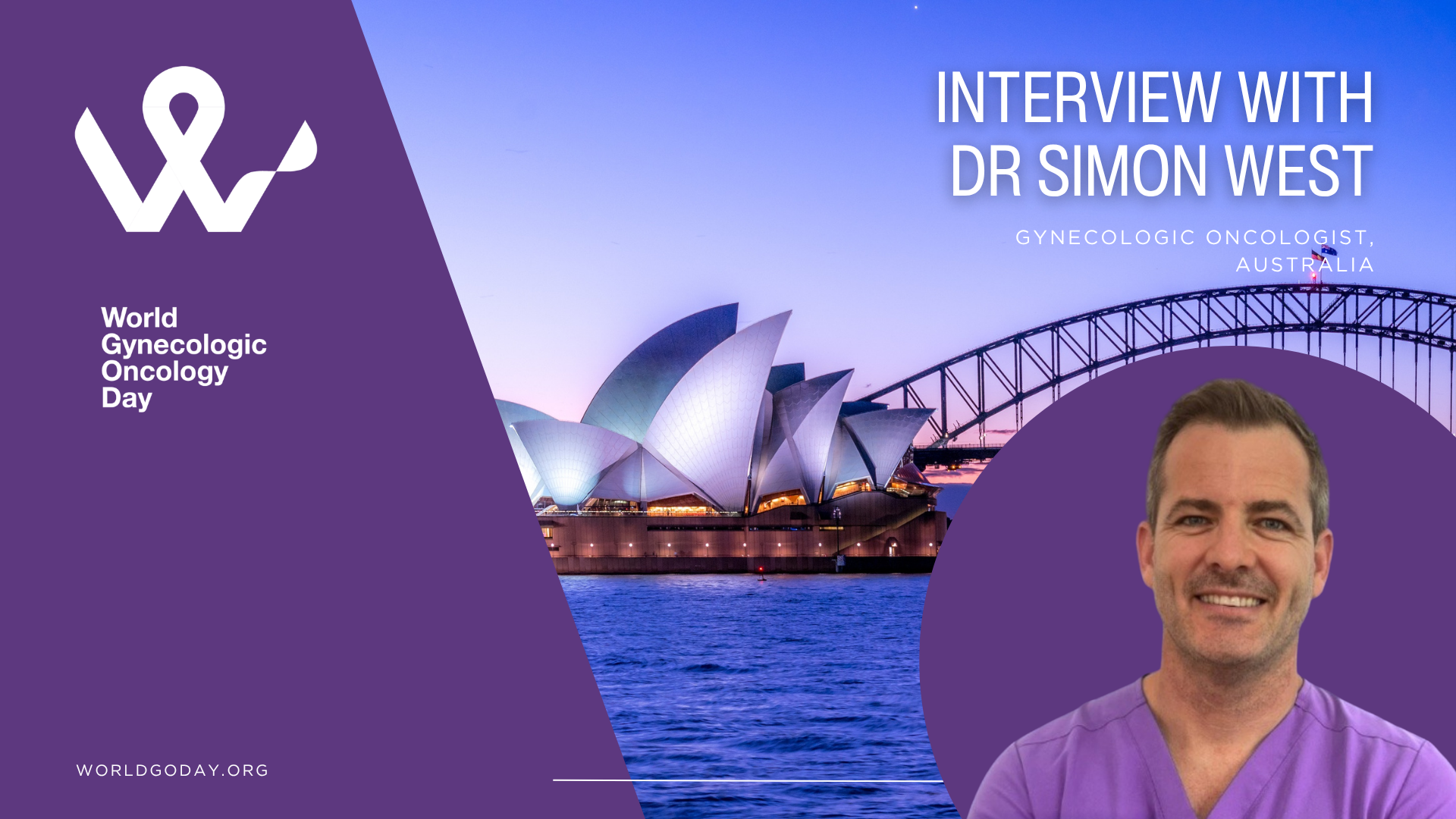
"The Cancer Doesn't Care": Dr. Simon West on Overcoming Stigma, Remote Care, and Survivorship
Dr. Simon West is a gynecologic oncologist in Brisbane, Australia.
Watch the video on YouTube(opens in new tab)
We are talking today to Dr. Simon West. We had a little bit of a technical issue, but that's okay. We are going to bring him back on the call. He is a gynecological oncologist at the Queensland Centre for Gynaecologic Cancer, and Australia has some unique things happening in particular. Hey, you're back! Okay, good. Fingers crossed.
Thank you so much, Dr. Simon, for your patience. Let's start with: what's the situation right now in Australia for gynecological cancer patients? You guys have made news with some great positive results lately. Can you tell us about that?
SIMON WEST: The big thing that we're very proud of is cervix cancer. The cervical cancer vaccine was created by an Australian, so we're very proud of that. We've implemented a national vaccination program and a national screening program that theoretically should effectively eliminate the majority of cervix cancers. It hasn't quite reached that, but we've made some huge progress, and there's still some ways to go. As an Australian, with the cervix cancer vaccine, we're very proud of what we've contributed to the worldwide burden.
WORLD GYNECOLOGIC ONCOLOGY DAY: That's fantastic! What is the vaccination schedule like now? Is it gender-neutral in Australia?
SIMON WEST: Both boys and girls are vaccinated at the age of 12. We try to ideally give them some HPV prevention before they have any kind of sexual activity, and it's given as a school-based nationwide vaccination program. Parents can elect to omit that, but the majority of people do get primary vaccination. There is a catch-up scheme that we did implement, and there is a way you can do secondary vaccination, but primary vaccination is where it's at now, and we have really good programs for school-age children.
WORLD GYNECOLOGIC ONCOLOGY DAY: That's wonderful. This is the first year—I've been doing interviews for World Gynecologic Oncology Day with people around the world for three years now—and this is the first year people are telling me cervical cancer rates are down! This is the third or fourth interview I've had where people have mentioned it in their country. It's such great news.
SIMON WEST: It's absolutely exciting. As I said, there's still plenty of work to do, and there are still populations that are very vulnerable, but there is some positive news out there, which is great.
WORLD GYNECOLOGIC ONCOLOGY DAY: When we're talking about the challenges for gynecological cancer patients in Australia, Australia has some unique geography. How does that affect care?
SIMON WEST: For people in the big cities, it probably doesn't change very much. But for the people who live outside of the big cities, which is a lot of our population, they are often very remote from where gynecological cancer care is delivered. There's a huge burden of travel and isolation that they have to overcome. We're talking significant distances—London to Paris or London to Germany types of distances. People have to cover thousands of kilometers to get to the care that they need. Often, they are Indigenous people from remote rural communities, and leaving those communities is a huge deal. Geography and social isolation are probably the hardest parts of delivering care in a big landmass like Australia.
WORLD GYNECOLOGIC ONCOLOGY DAY: I've heard before of the Royal Flying Doctor Service. Does that also include oncologists?
SIMON WEST: In Queensland, Australia—which is one of the biggest states in Australia with quite a big landmass—we do an outreach service once a month to Townsville to try to capture a lot of the northern Queensland care so they don't have to travel quite as far. But for the most part, care is delivered in the big centers in the big cities, and unfortunately, there's still a burden of patients who have to travel.
WORLD GYNECOLOGIC ONCOLOGY DAY: With cervical cancer rates being down, what are the most prevalent gynecological cancers you see in Australia?
SIMON WEST: By far, the most common gynecological cancer we see on a daily, weekly, and monthly basis is endometrial cancer. It's a very common cancer that, fortunately, for the most part has relatively good oncological outcomes. But the cancer we're dealing with that is both common and a little bit harder to manage and get really good outcomes for is ovarian cancer. Endometrial cancer is our bread and butter, but ovarian cancer is another one where we have a lot of disease burden.
WORLD GYNECOLOGIC ONCOLOGY DAY: One of your big in-person awareness events happens every February, and that has a focus on ovarian cancer, right?
SIMON WEST: Ovarian Cancer Awareness Month. That's where we try to promote ovarian cancer awareness, encourage discussions about ovarian cancer and the lack of screening, push for investigation if you have abnormal symptoms, and highlight support programs. In Australia, we have the Teal Support Program through Ovarian Cancer Australia, which is a great nursing situation where patients going through a really tough journey have access to specialized support. It's invaluable for my patients.
WORLD GYNECOLOGIC ONCOLOGY DAY: Could you tell me a little bit more about the Teal Support Program? That sounds unique compared to what I've heard from other countries.
SIMON WEST: In Australia, breast care nurses were the initial big driver, where a dedicated nurse was allocated to a patient's care through surgery, radiation, and chemotherapy as a support person with medical knowledge who was separate from their social supports. The Teal Support Program for ovarian cancer follows the exact same model. For our ovarian cancer patients who go through neoadjuvant chemotherapy or radical debulking laparotomies, they see lots of specialists. Having a unique, central focus helps them understand and navigate that really complex treatment paradigm.
WORLD GYNECOLOGIC ONCOLOGY DAY: In Australia, gynecological cancers aren't something people are comfortable talking about on a daily basis, so having someone designated as a support person sounds amazing.
SIMON WEST: Absolutely. The stigma around reproductive or gynecological cancers is something we need to move past. The sooner we move past that and feel comfortable talking about it, the better we're going to be in terms of delivering patient care.
WORLD GYNECOLOGIC ONCOLOGY DAY: When we talk about stigma in different countries, what are some of the things that are stigmatized in Australia regarding these cancers?
SIMON WEST: t's the fact that they affect what people consider private parts. An 80-year-old woman with vulvar cancer may have neglected a lump on her vulva for a long time because she felt it was not something she was comfortable talking about. These are intimate parts of your body that you've been taught to cover up your whole life, and now we want to open them up and talk about them. I don't blame patients for feeling uncomfortable about it, but I would encourage people to know that in medicine and gynecology, we do this every single day. It is nothing to be ashamed of or uncomfortable talking about, whether talking to me as a male doctor or to a female doctor. Please be comfortable because we only want to help.
WORLD GYNECOLOGIC ONCOLOGY DAY: Do you think you have a slight disadvantage being a male gynecologist?
SIMON WEST: Yes and no. There's no doubt that some patients feel more comfortable with a female practitioner than a male practitioner. But there's a line that resonates with me from The Matrixwhere one of the characters says, "The machine doesn't care how old I am, it'll kill me either way." I like to tell patients that the cancer does not care whether I'm male or female—it's going to do what it wants to do to you, and I'm just here trying to help you through that. The cancer doesn't care, so we should all just try our best to get into a situation where we're comfortable with each other.
WORLD GYNECOLOGIC ONCOLOGY DAY: How did you get started with being interested in gynecological cancers? You mentioned before that you were initially focused on obstetrics.
SIMON WEST: When you start training in Australia, you do general obstetrics and gynecology training, and obstetrics was what drew me to training initially. But as time went on, I met inspiring people and got my foot in the door with gynecologic oncology. From the outside, gynecologic oncology looks pretty grim, dark, gloomy, and ominous. You think, "Why would I leave this wonderful world of obstetrics where everyone is happy to go into oncology?" But once you get your foot in the door, it's not that at all. We do really good work, help a lot of people, and cure a lot of people. The biggest thing for me was realizing I could make much more of a difference in people's lives in oncology than I ever could in obstetrics, and that was a better legacy for me to leave.
WORLD GYNECOLOGIC ONCOLOGY DAY: When you talk with other gynecological oncologists in Australia, do they share a similar view on combating stigma and raising awareness?
SIMON WEST: Yes, across everything. Some love operating, some love interacting with patients and spending an hour and a half talking to them, and some are big advocates for women's health. You get a big mix, and everyone brings their unique perspective, which overall promotes a really good front and service.
WORLD GYNECOLOGIC ONCOLOGY DAY: Our focus this year for World Gynecologic Oncology Day is on support. Australia has a universal healthcare system, so financial provisions aren't as much of a burden, but what other kinds of support do you think are important when talking with a patient?
SIMON WEST: A big thing we're starting to do a reasonable job at is survivorship. We are often so focused on treating the cancer that we sometimes neglect what the treatment actually does to the patient. We pat ourselves on the back for curing them and walk away, leaving them with treatment side effects, anxiety about recurrence, and physical burdens. Recently, we've started to pay real attention to that. In Queensland, we've started developing survivorship clinics that help patients navigate life after treatment—addressing anxiety, treatment complications, sexuality, and relationships.
WORLD GYNECOLOGIC ONCOLOGY DAY: Is access to a psycho-oncologist available for patients in Australia?
SIMON WEST: Yes, though not readily everywhere. Within those survivorship clinics, psychological support is available, including psychiatrists and psychologists specializing in oncology. We have people who are interested and available to help.
WORLD GYNECOLOGIC ONCOLOGY DAY: On a personal level, what do you think family members can do if a loved one has been diagnosed with gynecological cancer?
SIMON WEST: It's really hard on support people too because they are dreadfully worried. I always encourage support people to make sure they have an outlet for themselves. They bury themselves in trying to be the support person for the patient, but they are no good to the patient if they destroy themselves in the process. Loved ones and friends need someone they can rely on too, creating a village of support. Don't underestimate the value of an extra support person in that process.
WORLD GYNECOLOGIC ONCOLOGY DAY: Coming back to survivorship and your background in physiotherapy, what advice do you give patients regarding physical activity during recovery?
SIMON WEST: Within surgery, there has been a real push toward rapid recovery, which connects to my background in sports physiotherapy. Getting people back on their feet and functioning again is critical. There is also evidence in other cancers that exercise during treatment is beneficial. Even beyond physical benefits, it provides immense psychological well-being. I encourage people to stay as active as possible and continue doing activities they enjoy—whether playing tennis, swimming, or playing mahjong. Continuing those outlets provides psychological well-being to help get through treatment.
WORLD GYNECOLOGIC ONCOLOGY DAY: Is there a final thought you'd like to offer to new doctors starting out or to patients?
SIMON WEST: Don't be afraid of having uncomfortable discussions, and don't be afraid of rejection. Put yourself out there. If you're passionate about something, you will eventually find like-minded people who share that passion. Open up those conversations, because a lot of people will keep things behind closed doors until someone takes the initiative to open the door.
WORLD GYNECOLOGIC ONCOLOGY DAY: Thank you so much, Dr. Simon, for talking with us today! Thank you to everyone who joined us live and watched! Please follow along for World Gynecologic Oncology Day on September 20th. Have a great day!
SIMON WEST: Thank you for having me. I appreciate it. Have a great afternoon or evening. Bye.