


"You Are Not Alone": Dr. Ana Conde Adán on Letters of Hope, Mental Health, and Care Access in Spain
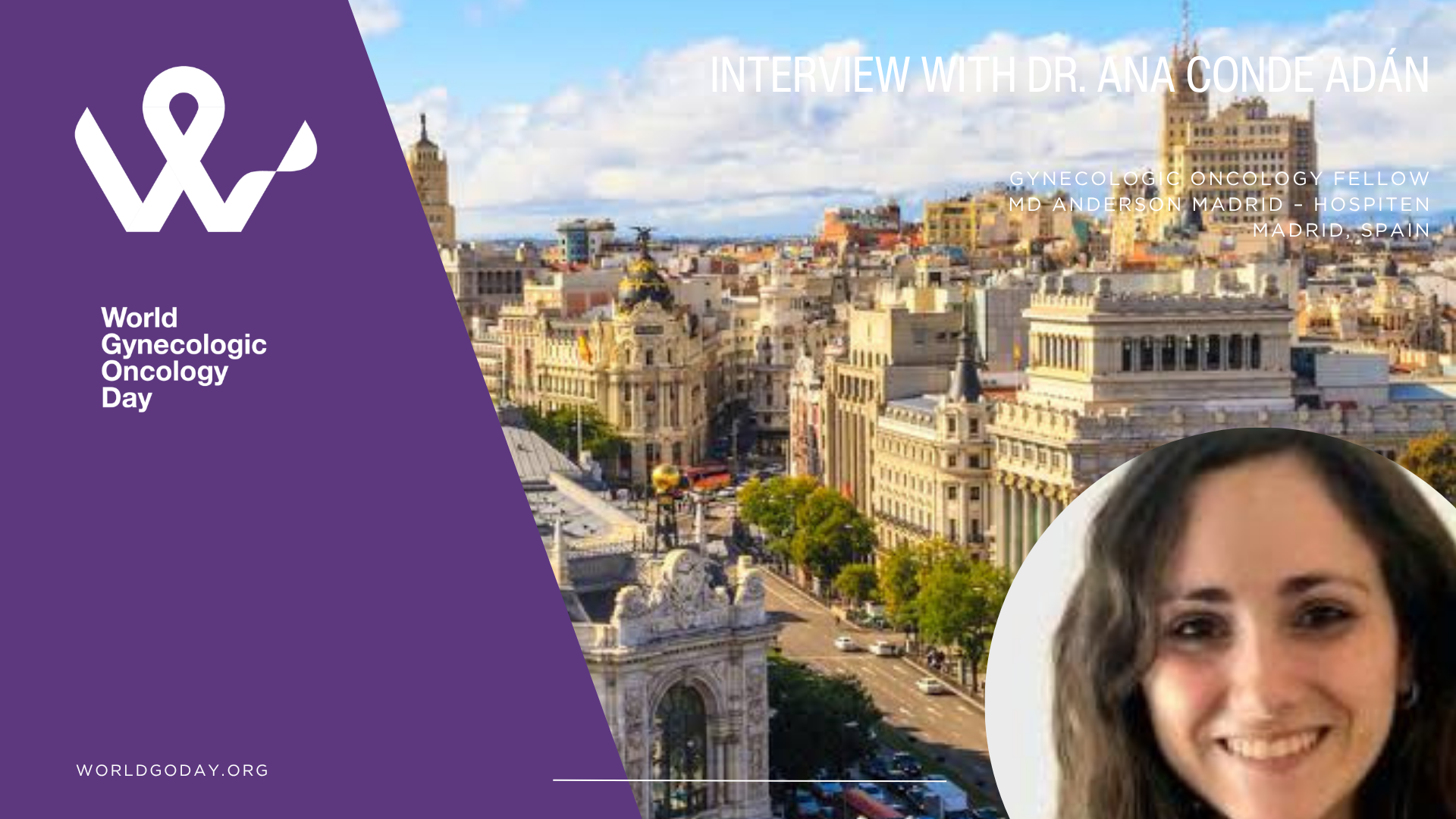
Dr. Ana Conde Adán is gynecologic oncologist at MD Anderson Madrid, Spain.
Watch the video on YouTube(opens in new tab)
ANA CONDE ADÁN: Hello! One minute, let me change the camera. There we go! Perfect.
WORLD GYNAECOLOGIC ONCOLOGY DAY: So nice to see you today! Thank you so much. My name is Beth from World Gynecologic Oncology Day. We are a global awareness project from the European Society of Gynaecological Oncology (ESGO) and the European Network of Gynaecological Cancer Advocacy Groups (ENGAGE). Our awareness day takes place every year on September 20th.
I'm so happy to talk today to Dr. Ana Conde Adán who is from Spain. She has long been a supporter of World Gynecologic Oncology Day and is very active with ENYGO, the network of young doctors within ESGO. She also came up with a really cool activity to support patients at her hospital, MD Anderson Cancer Center Madrid. Ana, could you tell us something about yourself?
ANA CONDE ADÁN: Yes, hello! I am really happy to be with you and to share this experience for our gynecological cancer patients. I work in a gynecological cancer hospital in Spain. I am trying to share this experience to help our patients feel more free, support their feelings, understand how they feel, and help share the idea that they are not alone.
WORLD GYNAECOLOGIC ONCOLOGY DAY: Every year World Gynecologic Oncology Day has a theme, and this year's theme is "Support, Not Stigma." I think the project you came up with last year really is a great example of this. Could you tell us about the project?
ANA CONDE ADÁN: Yes, of course! The idea is about writing a letter to a mystery friend—another patient—to share feelings about receiving a diagnosis, going through the disease, and offering advice or concerns. A patient gives a letter and takes a letter from another patient. It is a therapeutic exchange. They write down their feelings and emotions, and in return, receive advice from another patient who has gone through the same experience.
WORLD GYNECOLOGIC ONCOLOGY DAY: That's wonderful! Does this mean patients exchange letters on the same day, or is it over a period of time?
ANA CONDE ADÁN: We initially planned for it to run for a week or two, but the envelopes and letters were exchanging every day. Because people were so excited, we extended the project to about four or five weeks.
WORLD GYNECOLOGIC ONCOLOGY DAY: Wow, that's great! Did you have letters just from patients, or was it also open to caregivers?
ANA CONDE ADÁN: The initial idea was for patients to write and receive letters. However, we also provided an email address so people could submit letters publicly if they wanted broader diffusion. While the core idea was private—one letter for me, one letter for you—we also received submissions from caregivers and from doctors. Different emotions, feelings, and points of view were shared.
WORLD GYNECOLOGIC ONCOLOGY DAY: How did you come up with this idea? You mentioned that one of the reasons you specialized in gynecological oncology was to help patients with cancers that aren't as well-known. Was that part of it?
ANA CONDE ADÁN: Yes. Having a gynecological cancer can be especially painful for women. Every cancer diagnosis is difficult, but when it affects the gynecological system, people often feel more afraid, concerned, and face a lot of stigma or self-blame. These are often rare pathologies where accessing excellent care isn't as straightforward as it should be. I wanted to prepare myself to help these patients as best as I could.
WORLD GYNECOLOGIC ONCOLOGY DAY: Was the main goal to ensure patients didn't feel alone?
ANA CONDE ADÁN: Yes. In consultation, before or after surgery, we talk with patients, but sometimes they are too stressed or sad to process information. Patients are at different stages—some are newly diagnosed, while others have been cancer-free for three years. When listening to a doctor, a patient might wonder if we are just trying to convince them that everything will be okay. But when another patient who has walked the same path says, "It is going to be okay," it carries a different weight. It is easier to hear from someone who shares the exact same experience.
WORLD GYNECOLOGIC ONCOLOGY DAY: That is so nicely said! How long did it take to prepare this project at your hospital?
ANA CONDE ADÁN: The initial idea took a day or two. Then we spoke with our hospital foundation to produce the materials. The project was called Una Carta Para Ti("A Letter for You"). They created the paper, envelopes, and prepared a display table. In about 10 days, you can have everything ready if you want to implement this idea in your center.
WORLD GYNECOLOGIC ONCOLOGY DAY: That means other hospitals and organizations still have time to adopt this idea for World Gynecologic Oncology Day!
ANA CONDE ADÁN: Yes! I would be so happy if other centers shared this idea. It is about sharing, not stealing.
WORLD GYNECOLOGIC ONCOLOGY DAY: Are you planning a similar event this year?
ANA CONDE ADÁN: This year, we discussed setting up a question box. Because of the stigma surrounding gynecological cancers, women often have questions they are afraid to ask during consultations. They can write their questions on paper, send an email, or submit them via Instagram. Then, we will record a video addressing those answers to help more people.
WORLD GYNECOLOGIC ONCOLOGY DAY: That is a great concept—answering the questions people were afraid to ask their doctor! Would you mind reading a few of the letters from last year's campaign?
ANA CONDE ADÁN: Yes, for sure! This first one is from a patient who is now disease-free:
"Dear companion of this journey, receiving a cancer diagnosis can feel as though the world suddenly comes to a stop. You lose your breath, fear tightens in your throat, and a thousand thoughts rush through your mind all at once. It is a moment that shakes you deeply and it can feel as though life suddenly changes color. Fear, uncertainty, and unanswered questions all arrive at the same time. No one is ever prepared to hear that word.
I want to tell you something that perhaps you may not be able to see clearly today: you are not alone. When you walk into that doctor's office, into that consultation room where you are welcomed and cared for, a journey begins. Although it may be a difficult one, it is also filled with helping hands, invisible hugs, and people who know how to guide you with kindness, warmth, and respect.
The process is demanding, yes, but there will be days when you feel strong and others when everything feels too much. But even in the hardest moments, there is a light that does not go out. It has been a few years since I went through that storm, and I can tell you that life afterwards beats more strongly than ever. Both body and soul grow stronger through small gestures. I learned to embrace the little things: an unexpected smile, the sun on my face, the smell of coffee in the morning. This is the hidden gift of this journey—learning to look at life through different eyes: calmer, more grateful, more alive. Every step you take, no matter how small it may seem, is a victory. At the end of the road, there is life, there is joy, and there is a future."
WORLD GYNECOLOGIC ONCOLOGY DAY: That is so beautiful!
ANA CONDE ADÁN: Yes, I get emotional reading it. When a letter is handwritten on paper with a pen, it feels much more special than receiving an email or a text message. One patient wrote, "I send you this letter to help other patients, and I hope it provides as much comfort as I felt while writing it."
I also want to share a brief excerpt written for caregivers:
"Not enough is said about the role of the caregiver, about self-care, about that person who has to be there no matter how they feel for everything and everyone, always with their best smile so as not to show everything they are feeling inside. Not enough is said about us. We are rarely mentioned, and people rarely stop to think about what we need too. We need those wordless hugs, that look, that message of encouragement—someone asking if you feel like having a coffee, a chat, or simply going for a quiet walk. That simple question, 'How are you? How are you coping?'—how deeply appreciated those words are. Sending you so much strength, dear caregiver, and I hope this journey is as gentle as possible and has a very happy ending for both of you."
The writer signed off by sending an apapacho. In Mexican culture, an apapacho is defined as an embrace given from the soul.
Another patient wrote advice about social support: "I believe that the people I have chosen to have around me today are like vitamins for my everyday life. I chose them because my experience during illness taught me to surround myself with people who support me with encouragement, kindness, generosity, selflessness, and affection."
WORLD GYNECOLOGIC ONCOLOGY DAY: Patient associations play such a vital role in providing this peer-to-peer connection. In Spain, organizations like ASACO do incredible work supporting patient mental health. Speaking of psychological support, what is the availability of psycho-oncology services in Spain?
ANA CONDE ADÁN: Resources exist, but not in the quantities needed. Almost every cancer patient requires psychological support at some point during their diagnosis or treatment. Psychologists specializing in oncology provide essential tools to help manage anxiety and heavy emotional burdens.
In the public system, psychologists are excellent, but high patient volume limits the time they can offer. In private practice, specialized psycho-oncology care is available, but patients must pay out-of-pocket. Cancer-specific psychological care requires specialized training beyond general psychology.
WORLD GYNECOLOGIC ONCOLOGY DAY: What about support for sexual health and pelvic physical therapy for gynecological cancer patients in Spain?
ANA CONDE ADÁN: Sexual health experts and pelvic floor specialists are not widely integrated into the public healthcare system. Often, patients assume sexual side effects or physical changes are unavoidable consequences of treatment and relinquish that aspect of their well-being.
It is important for clinicians to proactively ask about these issues, as physical side effects—such as vaginal changes or pain—can often be addressed. Many patients simply do not know that specialized support is an available option. Because treatments like surgery, radiotherapy, and chemotherapy directly affect the pelvic area, addressing these side effects is essential.
WORLD GYNECOLOGIC ONCOLOGY DAY: What are some structural challenges unique to the healthcare system in Spain?
ANA CONDE ADÁN: Spain has a unified public health system divided across 17 autonomous regions. Each region manages its own resources and budget, meaning available treatments and specialized services can vary depending on where a patient lives.
Additionally, because most gynecological cancers—aside from endometrial cancer—are classified as rare diseases, surgical volume and specialized experience vary between hospitals. Concentrating complex cases in high-volume, centralized cancer centers ensures better management of complex cases and complications.
WORLD GYNECOLOGIC ONCOLOGY DAY: Has the incidence of cervical cancer changed over your time in practice?
ANA CONDE ADÁN: Yes. Screening programs and HPV vaccination for both girls and boys have significantly reduced cervical cancer rates. It is vital to remind the public that HPV vaccines are safe, effective, and save lives.
WORLD GYNECOLOGIC ONCOLOGY DAY: Do you have any final advice for clinicians planning awareness activities or for patients?
ANA CONDE ADÁN: Even if an initiative feels small, if it helps just one person, it is completely worth doing. Do not be afraid that an event isn't large enough.
I will close by reading one final letter from last year's campaign:
"Dear friend, I am writing to you after having gone through gynecological cancer. I remember well the fear, the sadness, the uncertainty, and the anger. But I also remember that I learned to live each moment as it came, moving forward step by step, trusting the doctors, my body, and time.
It is not an easy path, but I am here. I want you to know that you too will find your own way to get through it. If you are tired, if it feels unfair, if you ask yourself 'Why me?', you have every right to feel that way. You do not have to hide or be strong all the time.
I want you to know that you are not alone. Although every journey is different, we share the same hope to move forward and feel calm again. I am sending you all my energy and a huge hug."
WORLD GYNECOLOGIC ONCOLOGY DAY: That was beautiful! Thank you so much, Dr. Ana, for sharing these inspiring letters and for all your hard work.
ANA CONDE ADÁN: Thank you! Bye!