


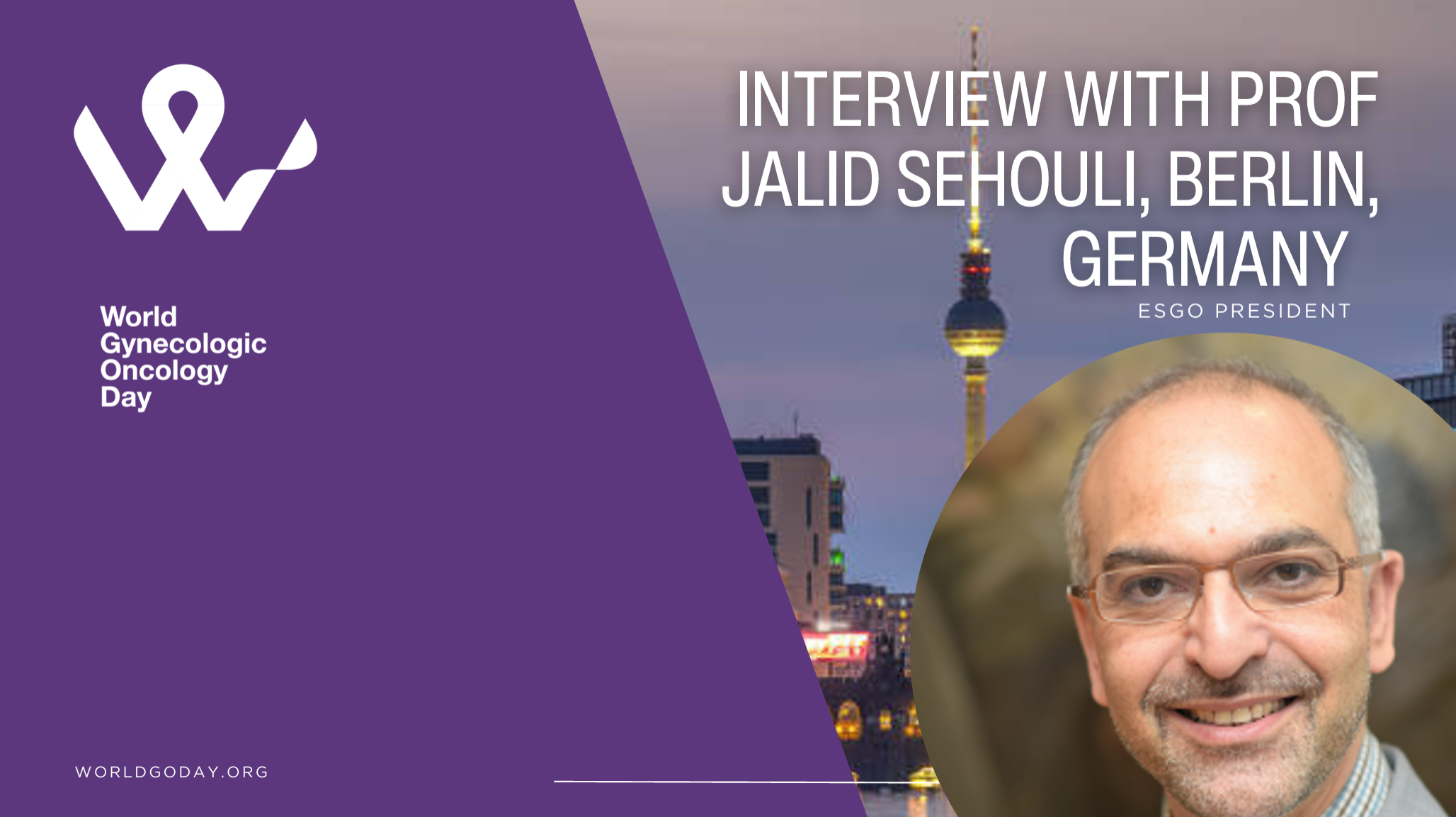
Prof. Jalid Sehouli is the current ESGO President, founder of the Ovarian Cancer Foundation, and Director of Gynecology at the Charité Campus Virchow-Klinikum in Berlin, Germany. Apart from being a world-renowned doctor and researcher, he is also an author, a passionate advocate for patient empowerment, and the driving force behind the annual ovarian cancer awareness parade in Berlin.
Watch the video on YouTube(opens in new tab)
World Gynecologic Oncology Day: Welcome from World Gynecologic Oncology Day! Today we have a really fun interview planned with ESGO president Dr. Jalid Sehouli. So I'm just going to bring him on the line. I hope that everybody is having a great start at the end of June. It's been very exciting that we have a lot of events being planned on our website. All right, and we are here. Thank you so much. Hi, we made it!
World Gynecologic Oncology Day: Professor Sehouli, thank you so much for taking time to talk to us again. I think the last time we spoke on the Instagram live was exactly a year ago here, so we're so pleased to have you again. For anyone who is tuning in, Professor Sehouli is the president of the European Society of Gynecological Oncology—you can see the logo behind him, very nice. World Gynecologic Oncology Day, which I represent, is an awareness day for gynecological cancers that was started by the patient network of ESGO. World GO Day and ESGO are very closely combined, and we're so happy to have your support for our awareness campaigns. You are a very big proponent of awareness.
World Gynecologic Oncology Day: I always love watching in May when you and the local patient advocacy groups go through Berlin, where you're based, with a big parade for ovarian cancer awareness. Can you tell me about that event? It's so fun.
Prof. Jalid Sehouli: Yes. First of all, thank you very much for your outstanding engagement because I think patients' empowerment is one of the key drivers to preserve and to get quality in diagnostic treatment in cancer care, and we need your inspiration. So I really love it, yes.
Prof. Jalid Sehouli: The World Ovarian Cancer Day is a political action. I introduced the Ovarian Cancer Foundation 20 years ago because I have seen that many patients are stigmatized in cancer. I think that will be maybe even a topic today—we need to go to the street. If the street doesn't come to you, you have to go to the street. I think in medicine, even as a doctor or as a researcher, I'm responsible to reach the community, to reach the patients, and not just wait.
Prof. Jalid Sehouli: It's so important to make these topics visible for everybody—for civil society, but even for the politicians—and to bring the patients' voice and the patients' perspective to our community. This is the reason why every year we do this World Ovarian Cancer Day, and I'm so proud it is becoming bigger and bigger. It's really wonderful.
World Gynecologic Oncology Day: That's great. Speaking of stigma and taking things to the street, gynecological cancers are still not discussed enough, even though you started 20 years ago. What do you have to say about that? How can we change it?
Prof. Jalid Sehouli: Yes, I think it's very important. Knowledge is overwhelming, but nevertheless, many decision-makers believe ovarian cancer or other cancers—even if they are early or advanced diseases—have no treatment options and there's no treatment for survival, which makes no sense. So it's really a question of knowledge, and secondly, it's a question of attitude where minimal support is there. I think we have to strengthen our stakeholders and work as an alliance. This is wonderful, and I'm so proud to be the ESGO president where, aligned with patients' advocates, young doctors, and experienced experts, we are moving in the same direction. I think this makes a difference.
World Gynecologic Oncology Day: Yeah, it's really nice to see how many people come together every year for cancer awareness, for individual cancers like ovarian cancer and endometrial cancer. Then we have, of course, World Gynecological Oncology Day, which takes place every September 20th. When we're talking about policy makers, politicians, and decision-makers, how do we best get their attention? Talking on social media does a lot, but what else do you have in store? What do you have planned?
Prof. Jalid Sehouli: First of all, we must not always blame the politicians. Secondly, we have to blame ourselves, because if we do not have a clear message, how can they understand? If we are not running as an alliance or as a group, then our voice is quite low. This is the first step: understanding that even if we have high research results, we must translate the message into an understandable language. We need to think about demanding things, but at the same time, think about what the solution can be, because at the end of the day, it's our work to solve the problems. This was ignored in the doctors' communities for many years, so this is the first step.
Prof. Jalid Sehouli: The second step is that communication must be clear and sustainable. It's not enough to make just one campaign; that's the reason why World GO Day is every year. It's a stone-by-stone evolution. Secondly, we must think about how we can strengthen our outreach. Work with media, work with politicians. To change politicians, we need a majority, we need a big noise, and we need a relationship with them. That's the reason why we asked to create programs for legacy, and that's the reason why ESGO switched from Switzerland to Brussels. It's not just a German topic; it's a European, global topic, and that's the reason we have to go directly to where they make the law.
Prof. Jalid Sehouli: But it's not simple because it's time-consuming. They are trained to talk, they are not trained to solve problems, and some of them only think about one, two, or four years. But there are some politicians with a good heart; we have to identify them and strengthen them. This is crucial to having a clear message, bringing alliances, and showing what the solutions can be.
World Gynecologic Oncology Day: Right. Do you have any advice for the doctors here whose names I recognized? We have Dr. Nagam, Dr. Ahmed, and I think some other people like Miss Turtle Doc, Romise, and Fritz. Thank you everybody who has come on and said hello and waved at us. Do you have any advice, Professor Sehouli, for doctors who know they need to join their voice to make this noise but aren't sure where to start? Maybe they're shy or uncomfortable talking like this on Instagram. How can they join? Joining ESGO is a big start, right?
Prof. Jalid Sehouli: Yes, it's a big milestone to enter ESGO, look around, get experience, and understand the system, because the healthcare system is very complicated. I'm now 30 years in the field and I'm still learning, but you have to know how politicians work, how insurance companies work, and how all the hospitals and private practices function. You have to understand that the elements to change the system are very colorful.
Prof. Jalid Sehouli: First of all, understanding how to speak with politicians is something different than talking with a patient. Again, you have to be very clear and make simple messages. If you as a researcher say, "It can be," "I cannot exclude," or "There's not enough evidence," then you show leakages and weaknesses. It must be very clear but honest, and you must think about how to get the majority of a party or a group. It's an evolutionary topic, but it's wonderful because if I do science, it's good to have individual experience, but bringing it to a European or global level is different and makes a real difference. If you create a diagnostic standard operating procedure, it's nice to have it for your environment, but making it a European or global guideline—and translating it to regions with limited resources—is wonderful. This is the opportunity ESGO gives to you.
World Gynecologic Oncology Day: Yeah, and you're referencing the resource-stratified guidelines projects, right? Can you remind our audience what that's about in case they don't know?
Prof. Jalid Sehouli: Yes. The backbone of guidelines is generally evidence-based medicine from trials or randomized phase-three trials from Europe, the US, or Asia. But then they have to be translated to regions that may have no access. How do we prioritize and adapt without compromising efficacy? Some treatments are a can, some are assured, and some are a must. This is something that would help give patients opportunities, even in Western countries, and allow us to work together to create more access for every patient.
Prof. Jalid Sehouli: It's a reality that even here in Berlin, one of the richest cities in the world, there are several patients and women who do not have access to the best quality of diagnostics, treatment, or cancer care. Sometimes this happens due to financial, educational, or institutional dependencies. We have to understand this. We are citizens and we need to be global citizens, because if you look at war and all the attacks we see every day, it's horrible. Let's connect these things, because if you talk about fear in a woman with cancer, you cannot ignore her fear of losing her partnership, losing her job, her relationships, or her fear of war or other diseases.
World Gynecologic Oncology Day: Yes. Doing this series of interviews, I've had the privilege to speak with patients and doctors from around the world, and it's amazing to see the different struggles people face. Every region is unique. It's very nice to be able to provide something so that at least there's one less thing they have to worry about. You've said a couple of times that "women's health is global health." How do we approach global health in a way where everything is so divided by resources or training?
Prof. Jalid Sehouli: I think it's very important to understand that if we talk about climate, it's global; if we talk about education, it's global; if we talk about migration, it's global; so if you think about health, it's always global. Health is defined by the WHO as a state of global physical, mental, and social well-being—this is the core definition of health.
Prof. Jalid Sehouli: What I want to see is women living long lives everywhere. If we talk about women's health, we know that many things are not adapted to it, even though women's health is the primary quality indicator for any healthcare system. It's a shame that many governments, even in Europe, have not addressed this in their protocols. How can you talk about diversity if you ignore women's health? Women are the backbone of global health. If you look at treatments, they might first be approved in the US, or a drug is developed in China, and we do cross-continental trials. At the end of the day, every individual medical procedure is linked to global health.
World Gynecologic Oncology Day: Yep, it's fun when you start looking at the pieces and seeing where all the threads go. Zooming in to something you mentioned: if you are a woman in Berlin right now and you don't have the privilege of an education that might help you, and you receive an ovarian cancer diagnosis, what can you do? How do you talk to the doctor in this situation? One of our campaign themes this year is about supporting patients, and it's hard to understand where to begin for some populations.
Prof. Jalid Sehouli: Absolutely. First of all, we have to accept—both advocates and the medical profession—that so far we don't reach every woman. There are different reasons; it could be co-morbidities or the frailty of a patient who is too sick. Secondly, we might exclude them through our materials. Think about the wonderful materials we have from ENGAGe and other institutions, but generally, they are only in a few languages. Even when you translate them, it's not enough because you need to adapt to intercultural nuances; some people are more trained to listen, while others learn visually. It's very important to understand that every individual has a different perspective, and we must not rush into stereotyping patients.
Prof. Jalid Sehouli: Take migration, for example: what does migration mean? First generation, second generation, third generation? We know that migration itself is not an independent factor in medical access; it is more about education, experiences, and the economic environment.
Prof. Jalid Sehouli: Nevertheless, what we are doing next week through a charity is hosting a session for patients, relatives, and nurses. We are doing it simultaneously in German, English, Arabic, Russian, and many other languages using digital solutions. We are also doing podcasts for patients to reach them, because reproducing the exact same text copies is not enough. At Charité, we started to develop specific videos and movies for patients, and we incorporated them from the very beginning. If you develop materials for a target group, you have to involve that group from the start—and that's what we do at ESGO. No guideline is created without patient advocates, and no campaign is run without asking them first, to ensure we avoid our own blind spots where we think we know what is good for patients but never actually ask them.
Prof. Jalid Sehouli: The same applies to trials: if we think about exclusion criteria, we must lower the barriers. Co-morbidities or secondary diseases should be accepted because there is enough evidence that it is not inferior.
Prof. Jalid Sehouli: Social media is also important. Why not dance on TikTok to talk about clinical trials? At the end of the day, I want to reach as many women as I can. Think about the channels they use, use them to interact, create trust, and invite people to personal meetings.
World Gynecologic Oncology Day: Creating that trust is so hard to capture if you don't have patient involvement. We have a comment here from someone watching, Miss Turtle Doc, who is a GP. She wrote earlier in the comments: "So true about politics and deficiencies in women's health even in Europe. I'm in the UK. Primary care is the first contact for women here and we are very overwhelmed by patient demand in general." Do you think that it's similar in Germany?
Prof. Jalid Sehouli: Absolutely, yes. I am very proud of the colleagues from the UK because they started very early to reach out directly to the community. This is something that Germany and many other countries have not done as early. But again, there's always space to improve.
World Gynecologic Oncology Day: Yep, for sure. Well, thank you for the comment! This year's campaign theme, as I mentioned, is "Support not Stigma." You've covered this a bit already, but what specific advice do you have for younger doctors—the ENYGO fellows who sometimes take part in these calls—when starting their careers? They want to get the noise out and support patients, but what is the first thing they need to remind themselves?
Prof. Jalid Sehouli: First of all, learn to listen and learn to watch. When I was a young doctor, I joined an advocacy society and was deeply impressed by their knowledge and how experienced they were at navigating the system. Even though you studied medicine, in some areas a patient can be much more competent than a doctor, and that's perfectly fine. So, the first step is to listen to people.
Prof. Jalid Sehouli: There is a very famous story in Germany called Momo. Momo always received secrets from people, despite the fact that he knew nothing, because he knew how to listen. Listening is key.
Prof. Jalid Sehouli: The second thing is being in the system to understand how to develop webinars and materials. When I was a young doctor, I introduced the first ovarian cancer brochure in the world back in 2006. When I started to translate it, I understood how difficult translation really is. It is the same as with surgeries: if you want to become a good surgeon, you have to watch many operations—both good surgeries and bad surgeries—and you need support to reflect on quality to develop to the next level. By being in advocacy, listening to patients, and observing their demands, we started together. At the end of the day, it's an alliance where patients act as co-scientists and co-creators. It will not diminish your competence or break your hierarchy; it will make you grow. Everyone expects you to be trained, but what they do not expect is for you to listen, gain new knowledge together, and change behavior. This is wonderful.
World Gynecologic Oncology Day: Yeah, doctors aren't expected to be at the end of their learning; that's just the start. We have some more people to say hello to: hello Anton, Majoen, Dorosa, and Vikasha—a friend of the channel and one of the very first founders of World Gynecologic Oncology Day. Thanks for stopping by.
World Gynecologic Oncology Day: Does anyone watching have more questions for Professor Sehouli? Please ask them in the comments, otherwise, I will just keep asking him to talk.
World Gynecologic Oncology Day: You mentioned earlier that to get the attention of politicians, we need simple, clear messages. I wanted to draw attention to an amazing piece of news out of the UK today, which I hope will cause a lot more awareness about gynecological cancers: cervical cancer has shown amazing results due to the HPV vaccine. Can you talk about that a little?
Prof. Jalid Sehouli: Yes, it's a shame that a cancer we can prevent is not being prevented everywhere. Vaccination and stopping smoking are the best approaches to preventing many cancers. The knowledge is clear, and to see a second country now showing that within a specific age group there are no new cancer cases is wonderful.
Prof. Jalid Sehouli: If you, like me, know how aggressive our treatments can be—regardless of what we say, it is aggressive for quality of life, for the pelvis, and for the woman—preventing even one case is wonderful. Again, I blame ourselves and the system because prevention is not truly integrated into our healthcare systems; it is still triggered primarily by repairing diseases. Prevention, vaccination, identification, and screening are the most effective strategies. This is wonderful news, but we have to take this knowledge and apply it; it's less a question of knowledge and more a question of translation and prioritization within the healthcare system. Do we as a society in Europe want to prevent cancer or not? If we say yes, there is no doubt that cervical cancer has to disappear according to the elimination program of the global WHO.
World Gynecologic Oncology Day: That's right. I was just so excited to see that news today because I am speaking to you today, and next week I have an interview with a cervical cancer survivor from the US, Samantha Gonzalez Russell, next Monday. I'm excited to hear her reaction to that as well.
World Gynecologic Oncology Day: Professor Sehouli, we are almost out of time. I just wanted to say thank you again for coming on, talking to us, and raising awareness about these cancers. Do you have any final thoughts?
Prof. Jalid Sehouli: Yes. First of all, I want to thank you personally, because your smile and your dedication are amazing. It's not only for one day; it's all days and nights that you dedicate to empowering women, sharing information, and respectfully bringing this message to the community, to us, and to our patients. It should be a structural part of every medical institution.
Prof. Jalid Sehouli: I want to leave you with hope—hope that together we can make a real difference in care. I know there are major leakages, limited resources, and a huge demand for more time and opportunities. This serves as the core motivation for ESGO across all our groups and committees. We will change the system step by step, but we need your support to make it louder.
Prof. Jalid Sehouli: We must also understand that quality of life is undeniably important, but you must look into your own soul and brain to define what quality of life means for you personally. Secondly, when doctors give you a recommendation, ask them: "What are the opportunities, and what is the evidence behind them? Is it survival? Is it a response? Is it quality of life? And what is the time toxicity for me, my relatives, and my kids?"
Prof. Jalid Sehouli: Showing patients all their options is missing in the current system. As president, I try to bring up the issue of "time toxicity" so that we have a much more transparent, shared decision-making process, because at the end of the day, it is your life. You have to dominate the direction of the treatment; it cannot be the doctors alone deciding on your quality of life. You have to challenge the doctors to open their hands, open the file, and if they don't know the answers, provide opportunities for a second opinion—because the quality of treatment is not equal everywhere. Being with a doctor who thinks they know everything and offers no other options is not my vision of medicine. You have to change that by working with ESGO and ENGAGe. Thank you very much for your personal engagement.
World Gynecologic Oncology Day: Thank you. I think that's a really powerful statement: "If your doctor knows everything, find a new doctor." All right, thanks again. This has been such a pleasure on a Monday afternoon, everybody. If you have questions for Professor Sehouli, you can leave them in the comments of this video and I will ask him to answer them later, too. Have a great day everyone, and thanks again. Take care. Bye-bye!