


Community Is Part of the Healing
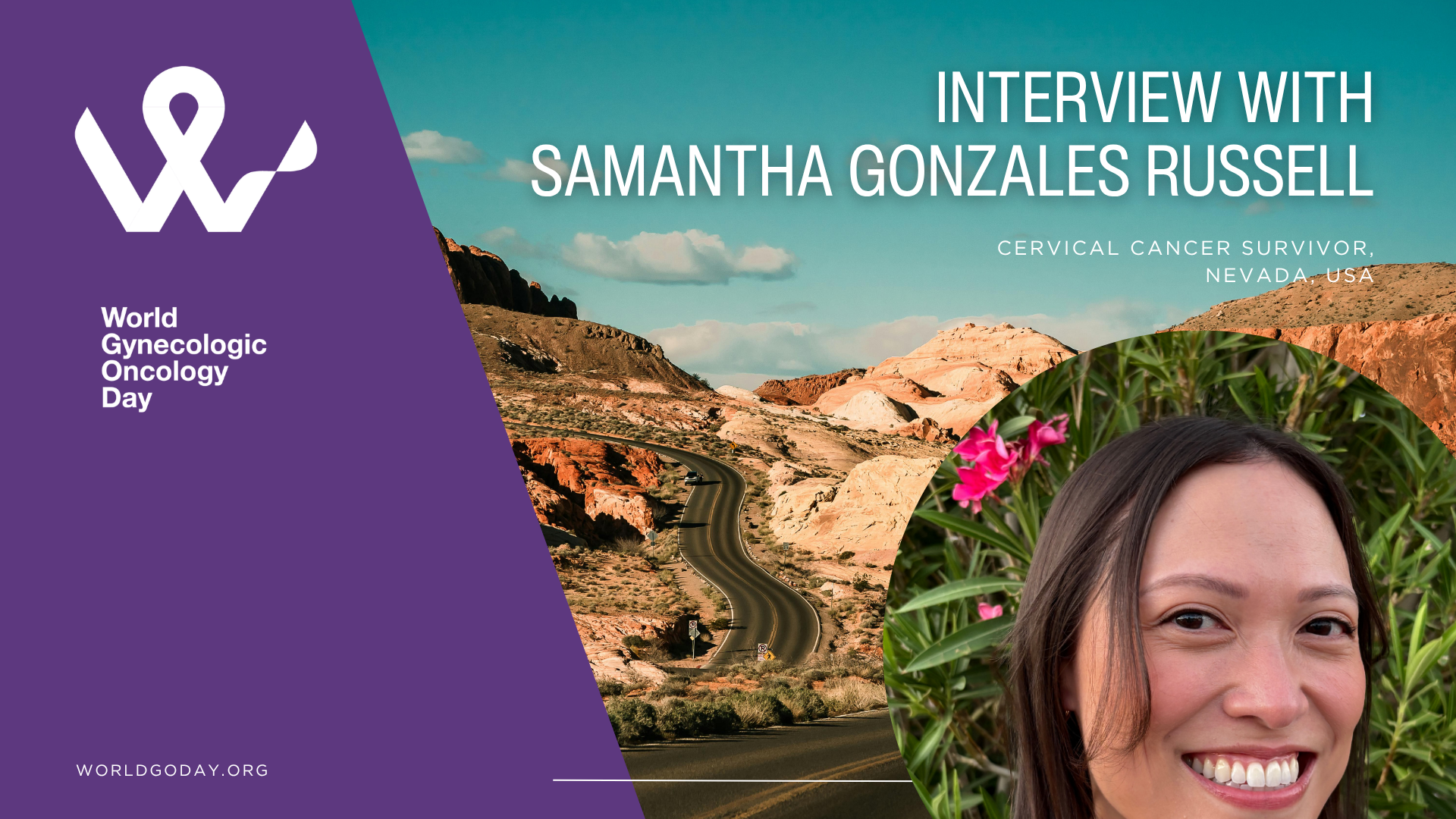
Samantha Gonzales Russell is a cervical cancer survivor from Nevada, USA.
Watch the video on YouTube in part 1 and part 2
World Gynecologic Oncology Day: I'm Beth with World Gynecologic Oncology Day. We are an awareness project about gynecological cancers — cancers that affect the female reproductive system, for example cervical, ovarian, and endometrial. I'm really excited to be interviewing today Samantha Gonzalez Russell about her advocacy work and her survivor journey. She is a three-times cervical cancer survivor. And since then, you have made it your full-time job to invest in your recovery, which is such an amazing goal. Could you tell us something about yourself?
Samantha Gonzalez Russell: Thank you. Thank you for having me. I'm so excited to have this conversation, and I appreciate all the efforts that you and World Gynecologic Oncology Day do on behalf of patients and women. I have learned so much on my journey. It's been a unique one — a roller coaster, if you will. And from these life experiences, I've just been able to learn a lot about myself, learn about what it looks like to recover, and I've just been sharing what I'm learning, and hopefully people are able to use that on their own recovery journey as well.
World Gynecologic Oncology Day: It's no small thing to become a patient advocate, to become someone who tells their own story. You shared that you have a background in storytelling?
Samantha Gonzalez Russell: I do. Before I was diagnosed with cervical cancer, I was working at my local TV news station, and that was always a calling for me. I've always been compelled by stories. I've been interested in writing, and once I got out of college, I was very into video production. I spent some time as a video editor and then a promotions producer. It's been really interesting to see how my two worlds collide — I've combined them and work with what I have at this point. The lessons of survivorship, of all the changes we have to learn to navigate in women's health and cancer patient health, and hopefully being able to tell them in a creative way.
World Gynecologic Oncology Day: And your organization — Evergrow Healing Co — is that a space only for cancer survivors, or is it open to everyone?
Samantha Gonzalez Russell: It is for anyone who is called to work on themselves, who's called to work on their health and their healing. I just found that there were simple things I was overlooking that were very, very powerful for me — whether it was learning to move physically in a way that was supportive and helpful, or empowering myself with healthcare knowledge and navigation, and then also just having a creative outlet. Being able to inject some joy into my journey, having a space where I can express myself and get creative. There's certainly a part of your brain that a patient may not be able to access when they're in the thick of treatment. And that was something that gave me so much fulfillment and life post-cancer — just to have that open up for you after so long.
World Gynecologic Oncology Day: Yeah, it allowed you to connect with yourself after everything.
Samantha Gonzalez Russell: Exactly. It allowed me to process everything that I had gone through. And then one of the most important parts of that is finding the community — finding other women who have gone through what I've gone through, or who at the very least understand where I'm coming from. That is huge in anyone's recovery process.
World Gynecologic Oncology Day: What did one of your events look like? What did you do for World Gynecologic Oncology Day last year?
Samantha Gonzalez Russell: I'm very proud of it. We had the privilege of having a licensed social worker guide us through what it looks like to advocate for yourself when it comes to women's healthcare. That choice was inspired by my own journey of feeling dismissed, of feeling like I wasn't able to really raise my voice for myself — and also by meeting so many other patients who have similar stories and have felt the same way. She was able to use her expertise and answer questions. And as I mentioned, being able to enjoy things again is a huge part of that empowerment and that process. So of course we created art — we painted on canvas what each of our journeys of strength and resilience look like. And although they all looked very different, they were all really beautiful. It was a wonderful time for women to connect, to see and validate each other, and have some fun along the way.
World Gynecologic Oncology Day: That's a really beautiful and unique event. And on the self-advocacy part of it — do you have any tips you could share?
Samantha Gonzalez Russell: Honestly, I think advocacy grew organically for me. I was sharing a lot of my own personal journey going through treatment — partly because it's such an isolating experience. Looking back, I think it may have been my attempt at reaching the world and trying to connect on that level. And at the same time, it was something I hadn't really seen. I often felt like I must be the only person who feels this way going through cancer and recurrent cancer. So I just felt naturally inclined to continue sharing and talking about these things that might be uncomfortable but are certainly necessary to move the conversations forward. It's really just evolved from there. I've had the privilege of working with different organizations and amplifying the experiences and voices of patients — gynecologic patients specifically. It's not something that gets talked about enough, and I truly understand why. But I think now is a time where we can really stand up for ourselves and have these conversations, because they're going to impact us whether we talk about them or not. So we should probably get ahead of it.
World Gynecologic Oncology Day: Absolutely. And that's one of the themes from World Gynecologic Oncology Day this year — being someone who talks about symptoms, or who can be someone who listens about symptoms too. Our main theme this year is "Support, Not Stigma." What does the word support mean to you — what's the first word that comes to mind?
Samantha Gonzalez Russell: The first word that comes to my mind is presence. Truly. I think often times, when we want to support somebody we really care about, we are trying to think of solutions — someone else who dealt with the same thing, or any kind of fix. But I think most importantly, presence is showing up. And it's okay to say, "I don't know what to say, but I want you to know that I'm here." I've been lucky enough to have people like that in my life, and it has meant the world. Just knowing that they were sitting with what I was feeling — that I didn't have to carry it alone. We don't have to have it all figured out to be able to support. We just need to show up.
World Gynecologic Oncology Day: And I think for people when they hear that someone has a gynecologic cancer diagnosis — first of all, these cancers aren't talked about enough, so they might not even understand what, say, endometrial cancer is. A lot of people just aren't informed enough. And then I think a lot of people maybe disappear. Did you experience that — people stepping back?
Samantha Gonzalez Russell: I don't know that I had anybody ghost me — or maybe I did and I kind of got lost in the shuffle of everything. But certainly, going through this changes your perspective on so many things. There are people on the outside who have no idea what to say, and it's just easier to not say anything. It is a really complicated experience to navigate. And from a patient's point of view, I think there are a lot of relationships where you learn about yourself and you kind of grow from there, and decide how you want to spend your energy and your time. You know that it's valuable. So there's a lot of changes that come with survivorship.
World Gynecologic Oncology Day: Was there something that surprised you about what changed?
Samantha Gonzalez Russell: Everything. Everything surprised me. I think — and this is something we've heard from so many different patients — you have an idea that you'll sort of go back to normal. And I was pushing myself very, very hard to do that. It has taken so many different avenues for me to realise that the new normal is going to be very different, and that's okay. There's a lot of pressure to undo everything, and going through this experience there's a bottled-up energy of wanting to go back to life as you knew it. So you push yourself really hard and think that's going to be the way forward. But probably the biggest surprising thing to me was that I should actually be doing the opposite — giving myself space, taking the pressure off, digesting what patient Samantha went through, and making peace with each of those parts in order to move forward in a new way.
World Gynecologic Oncology Day: So there's a definite change in who you became versus who you were before?
Samantha Gonzalez Russell: Oh yeah, absolutely. In so many ways. I think just being kinder to myself has been the biggest thing. There's certainly been a shift in priorities. When I was first diagnosed, I was only 27 and in a completely different mindset. And sure, there's normal growth that happens in people's lives from 27 to now — I'm 37. But going through a gynecologic cancer, everything is compounded, and I probably gained a lot of perspective that I otherwise wouldn't have had.
World Gynecologic Oncology Day: And that's one of the reasons you chose creativity as a focus in your organization — because of this growth, which is, I suppose, right there in the name.
Samantha Gonzalez Russell: Yes, absolutely. As I mentioned, there were just a lot of simple things I wasn't doing for myself in this recovery process. One of them was offering myself a space to express in a positive way. There are a lot of emotions to express, and they're certainly coming out. But if I could create something that makes me happy when I look at it — something I really admire, or that's inspired by something beautiful I saw or experienced — that makes the expression even more meaningful. And it's just fun. It's fun. I also realised I wasn't having enough fun. I was so serious about recovery — I have to meet this milestone, I have to check off these goals. And so through therapy and just sitting with the process, I thought: okay, now I get to have a little bit more fun. Now I can really express myself authentically, and it feels good. So hopefully we can do that for others along their healing journey too.
World Gynecologic Oncology Day: That's wonderful. Thank you so much for making the time to talk with me today. Do you have any parting thoughts — what advice would you give to someone who is just starting their survivorship journey?
Samantha Gonzalez Russell: A huge one is to be kind to yourself. It's so much easier said than done, but it will make a huge difference — letting that pressure off, being where you are. Try to connect with the present as much as possible. And it's not the easiest thing to do after truly surviving, but I think it's absolutely worth it. Have that patience, that grace. Someone said to me that it helps to talk to yourself like your best friend — recognise that that person is the one who got you to where you are now. So be kind to them and offer them some compassion.
As far as advocacy goes, I think it's important to embrace your own journey and make sure that you're caring for yourself along the way, because sharing tough moments in your life can be an exhausting journey. But it is well worth it if you are able to manage and care for yourself in that way. And then also — start small. It's really easy to compare yourself to other people or see that someone else is doing a big campaign. But know that there are so many ways to be an advocate. It's really important to start with your community, in your own backyard, because they are in need of your voice and your story. Lean into community, because that is another component of healing that I was overlooking in an isolated state of mind. Being able to meet other people and support each other has really been able to turn so much around. So I would say: embrace your people.
World Gynecologic Oncology Day: That's a very beautiful sentiment to conclude on, and it really encapsulates a lot of what you've been saying throughout this interview. Thank you so much for having this conversation with us — and to everyone watching, please take a look at Samantha's Instagram page to find out more about what she's been doing, and also mark your calendar for World Gynecologic Oncology Day on the 20th of September. Thank you so much, Samantha.
Samantha Gonzalez Russell: Thank you. Thank you so much. It's been a pleasure.