


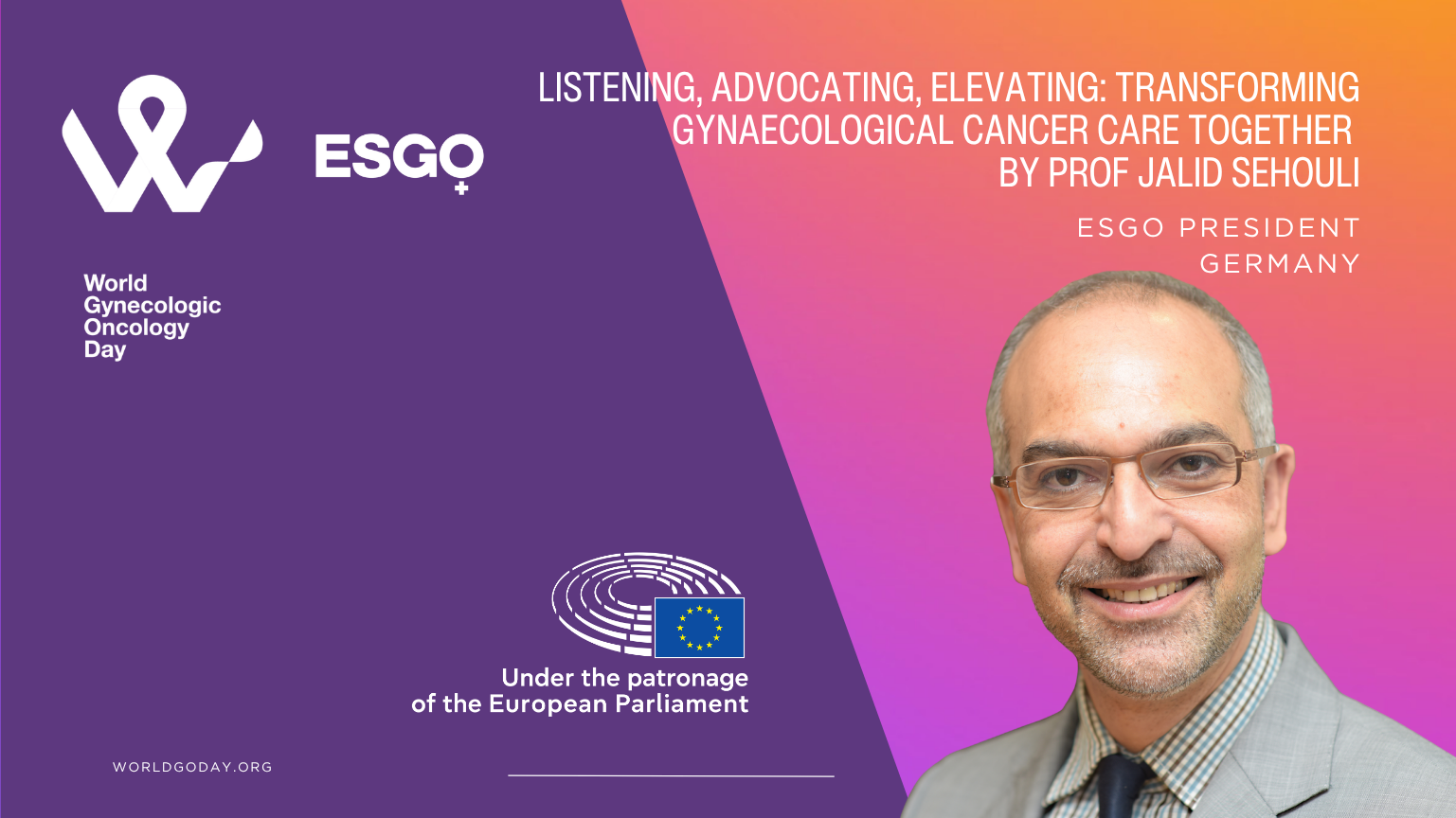
Listening, Advocating, Elevating: Transforming Gynaecological Cancer Care Together
Professor Jalid Sehouli
ESGO President
Stigma and silence around gynaecological cancers kills, while research and advocacy can save lives. As President of the European Society of Gynaecological Oncology (ESGO), I am always deeply honoured to mark World Gynecologic Oncology Day on September 20th. Beyond raising global awareness, this project calls on us to form alliances as a community and reflect on how we can genuinely transform care, through listening to our patients' lived experiences, championing health equity, and building systems that support women through every step of their journey, no matter where they live.
Designing care around what matters to patients
Putting patients at the centre of medical care and research sounds simple, but what does it look like in practice? A critical first step is exploring what ‘meaningful outcomes’ truly means to each individual, acknowledging that what we observe in our appointments with someone does not always capture the full scope of that patient's daily experience. Prioritising patient-reported outcomes and quality of life ensures that definitions of success align with real lives. By actively listening and inviting lived experiences into our work, healthcare providers can collaborate with patients to shape systems, workflows, and treatments that offer genuine support, from diagnosis, through treatment and beyond.
World Gynecologic Oncology Day is an occasion to consider the broader impacts of a cancer diagnosis on patients and their families, beyond a purely medical lens. I often speak about ‘financial toxicity’ and ‘time toxicity’, which, I believe, are not given enough consideration. How much time is lost by patients because of cancer? What is the financial burden of repeat appointments, examinations, treatment and travel? Is all this necessary and how does this impact patients’ and carers’ lives beyond measures of survival? What are the long term impacts of cancer on our patients’ lives? As doctors, we must think about not only whether a treatment will prolong life, but how much of a meaningful life it can provide, and at what cost and impact on the patient’s everyday life.
The words we use with patients matter
This brings me to the related topic of language – because words matter.
As clinicians we are used to a certain scientific language that doesn’t necessarily reflect the patient’s lived experience. For example, when we speak about a ‘positive result’, this may actually not be positive for the patient. When we talk about a ‘poor prognosis’, it may unnecessarily worry patients. And when we speak about ‘response’, we need to take a step back and think about how what we are about to share with them will impact their lives.
The medical language we use is shaped by categorisation, classification and standardised endpoints that are often difficult to understand for patients. We should critically reflect on whether these terms adequately describe the experience of those who they are characterising.
Global health and equity
Finally, I would like to speak about the issue of equity. As physicians, we have a responsibility to demand that health systems advocate greater equity, for our patients and all women facing gynaecological cancer.
Even where I live in Berlin—one of the world’s most affluent cities—we face a stark reality: many patients still lack access to optimal diagnostics, treatment, and ongoing care due to complex financial, educational, and institutional barriers. When we look beyond Germany, these disparities widen significantly, deeply affecting both the quality of cancer care and long-term survival outcomes for women across the continent.
These disparities spur ESGO’s drive to continue to advocate for equal chances across the EU. Through the creation of an EU-wide Network of Centres of Excellence, we believe women would have access to consistent, high-quality-care, and enable better research.
But ESGO’s responsibility goes beyond Europe. Our incredible community and network of experts must continue to translate their expertise for regions with limited resources. This work is vital for us to be truly globally minded, dedicated to reducing disparities and achieving global health, regardless of our backgrounds or European base.
Through evidence-based clinical guidelines, multidisciplinary research networks, and specialised training programs, ESGO aims to empower healthcare professionals to elevate standard of care everywhere. We are steadfastly committed to bridging healthcare gaps, driving systemic change, and eliminating regional disparities so that every woman with gynaecological cancer receives the high-quality care she deserves.
A call to collective action
This World Gynecologic Oncology Day, let us reaffirm our fundamental task: to listen to our patients and advocate for them. Centering patient care means looking beyond traditional medical metrics to address real-life burdens like financial and time toxicity, while carefully choosing words that respect and accurately reflect their lived experiences. At the same time, we must relentlessly pursue global health equity—bridging gaps in care and breaking down institutional barriers from local clinics to international systems.
As a community of clinicians, researchers, and advocates, let us come together and get loud with our collective voice to ensure that every woman, everywhere, receives the dignified, high-quality care she rightfully deserves.