


Demystifying Vulvovaginal Health: Why Self-Examinations and Education Save Lives
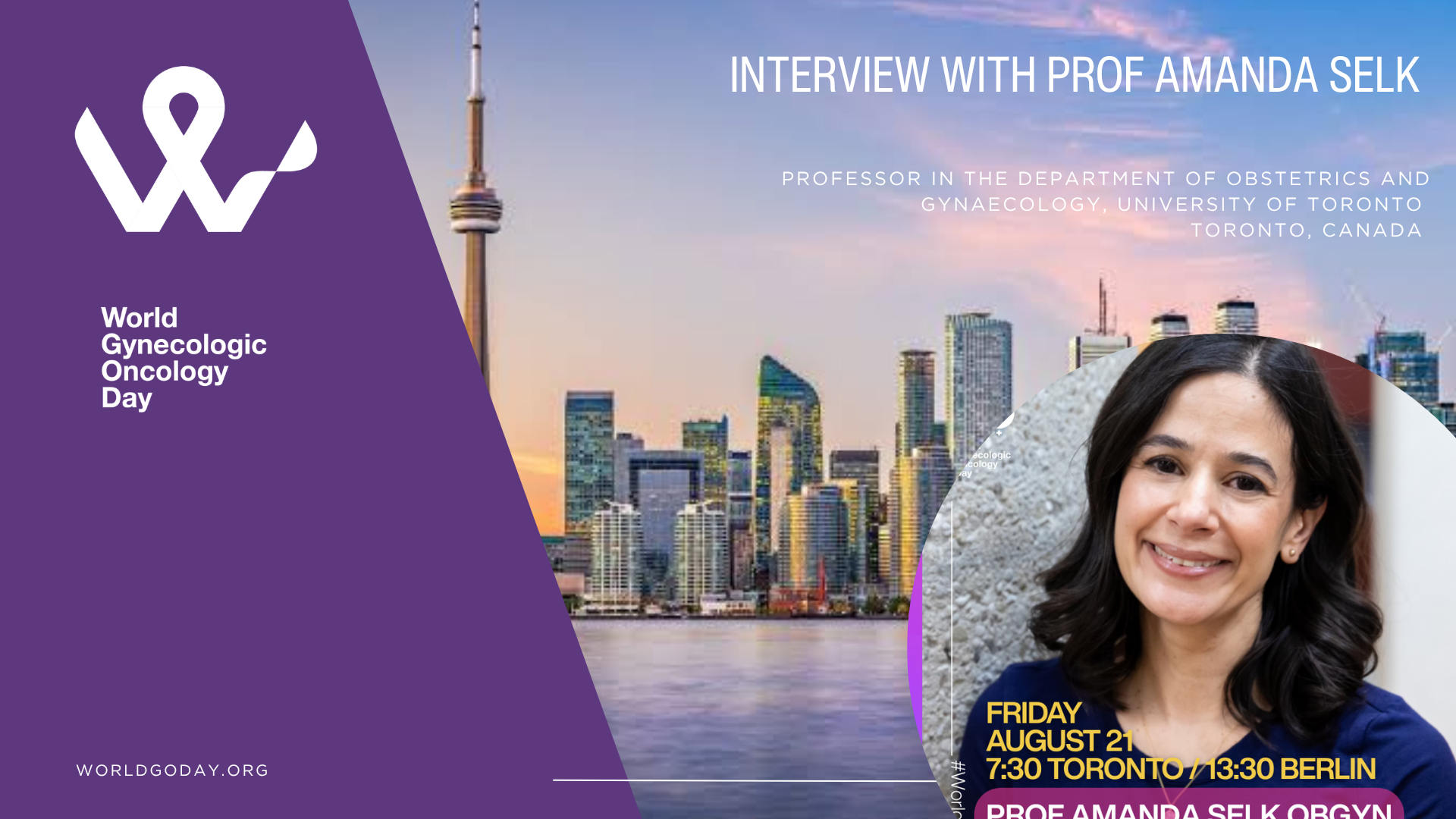
Professor Amanda Selk is a gynecologist and a Professor in the Department of Obstetrics and Gynaecology, University of Toronto, Canada.
Watch the video on YouTube(opens in new tab)
Hello to Canada. I am going to be having an interview today with Professor Amanda Selk treating gynecological cancer patients in Canada. Hello and welcome to the call. Thank you. That works perfectly. Thank you so much. Excellent. It was even less than 20 seconds, which is what I promised you. All right.
I'm Beth from World Gynecologic Oncology Day and I'm here with Professor Amanda Selk from the University of Toronto in Canada. We have a fun interview today planned to talk about gynecological cancer and cancer awareness in general but with a focus on vulvar and vaginal cancers. So, Professor Selk, could you please tell us something about your background and tell us about yourself?
PROFESSOR AMANDA SELK: I'm a gynecologist in Toronto, Canada. I have been a gynecologist since 2009, so quite a long time now. I did some extra training in dermatology and my gynecologic focus is actually all about precancers that are related to HPV of the cervix, vulva, vagina, but I also have a lot of gynae expertise in dermatology and diagnosing cancers. So that is sort of most of what I do. A little bit of menopause, a little bit of obstetrics, but that's my main focus.
WORLD GYNECOLOGIC ONCOLOGY DAY: And also, I should not forget to mention that Professor Amanda is also an educator online and offline. She has the very entertaining and also educational @Drselkdownthere on her Instagram account which you should all check out if you haven't already where she talks about things that we need to know as women or non-binary people about our vulvas which I don't enter in normal conversation.
PROFESSOR AMANDA SELK: I'd say that my account has some of that. It's really trying to educate people about women's health in general. So it has lots of gynecology, obstetrics, menopause, perimenopause, but yes, it may have a little bit more vulva and cancer than other accounts. I try not to make it just a vulva account, but I'm focusing on all of these.
WORLD GYNECOLOGIC ONCOLOGY DAY: Yeah, that's good. But I like it: @Drselkdownthere.
PROFESSOR AMANDA SELK: So, the words we use on Instagram and Facebook are really interesting because how we post and how we explain can affect our reach and how many people can see our stuff. So, I hate the term “down there” because I always think that it would be much better if people learn the names of everything, but when I was thinking about what would be a good account name to help show what I talk about, that would also not be banned in any way. That's where it came from: @DrSeckdownthere.
WORLD GYNECOLOGIC ONCOLOGY DAY: That's true. Have you ever come across some banning or what they call grey listing I think sometimes, shadow banning where you make the post and then it doesn't get shown to people on Instagram because of the words you use?
PROFESSOR AMANDA SELK: Yeah. I had not even just words but a really basic stick drawing of a vulva to help people understand where an anatomic issue could happen. They were like, "This goes against our account rules about what you can see," and it's ridiculous. It was like a drawing and I was like, "Really?" So again, it's really hard. How do you teach people what things look like? We're not putting up photos. I understand that, but we need to have something to help people understand, because how else are they going to learn?
WORLD GYNECOLOGIC ONCOLOGY DAY: That's right. And Professor Amanda is also the President-Elect of the ISSVD which is the International Society for the Study of Vulvovaginal Disease. Together with ESGO and ENGAGe, which are the entities that World Gynecologic Oncology Day is a project of, you created a self-examination guide for vulva cancer last year. I think one of the challenges in creating this guide for people was making some diagrams that showed how to check the vulva for cancer or precancer with beautiful flowers on it. So, it's an excellent resource.
PROFESSOR AMANDA SELK: And I'll be honest, that was one of my concerns about that document. Some of the feedback that I gave when it was being created is that I actually wanted it to have more pictures. But the feeling was that as we were trying to see what would work across the entire world and what people would be more open to, that was what we landed on. So, I think it's an excellent resource. But it is missing those photos. I will say if people want to see pictures of cancer and precancers and how to identify vulva stuff, the British Society for the Study of Vulval Disease—so you Google BSSVD vulval self-exam guide—they also have a very good guide full of pictures, and it's free, so that's another good resource. I love ours and I think it's important, but I'm a big fan of not reinventing work that people have spent a lot of time on, and I like to promote good work that other people have done. So, I think that guide is absolutely excellent if people want to see real pictures, and to me, that is a good place to go.
WORLD GYNECOLOGIC ONCOLOGY DAY: Thank you for that resource. That's a really good point to make because we have the flower guide, which is very cute and very pretty, and we can put that on Instagram. If you want to look in our reels you can find it. But sometimes a picture is really the best thing to know if this is something I should be concerned about.
PROFESSOR AMANDA SELK: Yeah. So, there are two excellent resources for people and you should probably use them both.
WORLD GYNECOLOGIC ONCOLOGY DAY: So, when you got started doing your Instagram account and promoting awareness about gynecological health online, what were you thinking—were you thinking that you'd do it for a couple months or…?
PROFESSOR AMANDA SELK: I've been involved in social media for actually quite a long time, but I was very reluctant to do this type of thing with me and my pace and all this talking online. Many years ago, when Twitter was a thing before X, I used it a lot because that was just little snips of text. Then a lot of things changed in that platform, and I lost my joy in using it and really didn't like it anymore, so I stopped. I had social media like podcasts—I had one way back in 2019 before most people ever had one—so I was involved in social media in different ways, but I used to keep my Instagram and Facebook more for my personal use and not for public use.
I really felt working clinically that patients would always tell me where they were getting their information from. They'd say, "I saw this online," not just googling anymore, but, "I saw this on TikTok. I saw this on Instagram." And I thought, I was so reluctant. People kept saying, "When are you going to do this?" and I said, "I don't have time. I can't do this. I don't understand it. I don't want my face out there." Then I was sitting in this room one day on a weekend and I decided I'm going to do it. It really was an experiment to see if I could get to more people by educating this way. I didn't really have big plans. I filmed myself in a room in my house saying, "Hi, this is who I am," which I think was my first post. Then my Instagram is really my stream of consciousness. It's things that came up in clinic, something I read, something that bothered me, something that my patients asked. It comes from all kinds of things. So you'll see how it jumps around from topics, but it's something that I think is important and people might want to learn about. It's been just over a year now.
WORLD GYNECOLOGIC ONCOLOGY DAY: I think it's really well done because this is the type of information that people want to get. They're sometimes afraid to ask their family or their friends, or they didn't know that they needed to know that, and then here you are providing the information in a way that is easy to digest and cute. I like it.
PROFESSOR AMANDA SELK: Thank you. So I started with Instagram. I realized that you can put the same things on Facebook very easily. It's fascinating to me because I can see the demographics of who's watching, and I actually have very different demographics on the two different platforms. Also, what seems to be important to people or has high interactions and more questions is also different. So, the same thing can have much more reach in a different way. Two weeks ago, I decided to take anything I've already posted and put it on TikTok or YouTube. I just started that the last few weeks and haven't put much effort into it; usually if I've already done something, I'll put it in those places just so more people will learn. That's really the goal: how to get to more people, and they all sort of attract slightly different groups.
WORLD GYNECOLOGIC ONCOLOGY DAY: Yeah, absolutely. We have a very different experience too. We notice from the comments that we get on Facebook and the comments that we get on Instagram.
PROFESSOR AMANDA SELK: I have people who are in their 80s following me, and they say, "I never knew this. I had no idea." We still don't talk about any of this enough—women's health and gynecology, and definitely not anatomy, changes, and what things look like. Certain generations really didn't talk about it at all, and even if it's becoming more common, it's still not common to talk about.
WORLD GYNECOLOGIC ONCOLOGY DAY: That's right. We're talking to Professor Amanda Selk, and if you have a question for her, please go ahead and put it in the comments and we'll try to get to it in the course of this call.
Professor Amanda, I'm always curious about the different challenges that face different places around the world. Canada, I think is really interesting and you're my first interviewee on this series of live interviews from Canada, so thank you for representing. What do you think are some of the major challenges or unique difficulties happening for gynecological cancer patients or gynecological health facing Canada right now?
PROFESSOR AMANDA SELK: Most gynecologic oncology care is centered in centers of excellence, so people have to go to an oncology center. Geographically we are a huge country with a relatively very small population, so people may have to travel quite far distances to access care, especially if they live in regions that don't have the care that they need. That's a big one.
Our advantage is that we have a public healthcare system, so there are no concerns if you have cancer; you will get very good care, and your surgery, radiation, and doctors are always covered. But it's that traveling. Our system works where your primary person is your family doctor or general practitioner. Some people don't have one, and that's a problem because your access to specialists is by referral. First, you see a family doctor, walk-in clinic, or nurse practitioner, and then they diagnose you and refer you on.
When we talk about traveling, if you need surgery, you can come have it and go home, but if you need radiation where you need it every day as a cancer patient, you may have to move to a bigger city for the time period of your care. This can happen in high-risk obstetrics as well where people have to travel. That is maybe different from other countries, especially Europe where the countries are small.
We don't really have enough doctors and specialists for the number of patients we have. The wait times in Canada to access specialists are documented as among the longest in the world. Once you have cancer, you're prioritized and things are much faster, so you're not waiting years to see anybody, but you can be very symptomatic with other non-cancer issues, and it can take a long time to get care. Once you get care, you get excellent care, but it can take time.
WORLD GYNECOLOGIC ONCOLOGY DAY: Right. One of the things that I understand is unique about your practice is that you are focusing not just on cancer, but on dermatological issues of the vulva, so you often have a lot of patients who don't have cancer but have long-term issues that they need care for. Is that right?
PROFESSOR AMANDA SELK: Right. Some of the conditions that I take care of are acute and short—we treat, you get better, and it's over—but there are some chronic, lifelong skin conditions. Some of them are very important, like lichen sclerosis or lichen planus. Lichen sclerosis has about a 3% risk of developing vulvar cancer over time, and the cancers associated with skin conditions are generally a little bit more aggressive and difficult than the ones related to HPV. Most vulvar cancers are related to HPV or an inflammatory skin condition. You can also get melanomas on the vulva, which are not related to sun exposure.
We educate all of our patients about signs of cancer, and some panic thinking they're going to get cancer. Actually, a very small number are going to get cancer, and cases are far higher in people who've never been diagnosed, don't know they have a skin problem, or are being under-treated. Once we've seen you and educated you, you have a much lower chance. Cancer outcomes are much better if we find them early, so teaching people how to find them early is key.
Vulvar cancer across the world is universally most commonly diagnosed at Stage 3. This is the issue across high-income and low-income countries. I think it's related to two issues:
- People are very embarrassed and don't want to go see anybody about their symptoms; they don't even realize that they can get vulvar cancer.
- Clinicians don't get enough education about what it looks like or what to look for. It's all about doing a PAP or HPV test and finding the cervix but not looking at the vulva or vagina to see what's abnormal. My American colleague says the vulva is like a small town: everybody drives by, but no one stops to take a look. Unless something is super dramatically abnormal or someone says, "Hey, this is bothering me," people don't see it.
There's also a fear of biopsying. Family doctors will biopsy your arm or leg, but fear biopsying the vulva. If you can do it in one part of the body, you have the same skills for another part, but if no one showed them, they get scared. Even general gynecologists sometimes don't want to biopsy because it takes time, but you have to biopsy the patient.
WORLD GYNECOLOGIC ONCOLOGY DAY: I think it's one of the more recent recommendations that a vulvar inspection should always be performed at the time of a pap smear, right?
PROFESSOR AMANDA SELK: I think that's coming. Organizations like ISSVD and ESGO promote it, but I don't think it has spread across the entire world yet. Anyone who takes care of vulvar cancers or lichen sclerosis would say to please look. With HPV screening, where if you're negative you can go to five-year screening in the vast majority of countries, that is a good test. However, on the vulva, you can have asymptomatic scarring skin conditions.
Some of these scarring skin conditions that can lead to cancer can also cause your anatomy to disappear—the clitoris can cover over, labia minora can disappear, and the vagina can narrow. These can be very life-altering.
In Canada, there is zero chance that a gynecologist is going to do an annual exam because we don't have enough people to take care of our complicated, sick patients. They can't do screening, which is where empowering people with the knowledge of how to examine themselves comes in. I did a "Check Your Velvet" study where people from 18 to 80 used a hand mirror to look once a month to get to know what they look like. If you notice something different—bleeding, cuts that don't heal, sore or hard areas, something rough, a new lump or bump, or something only itchy in one place—please go get someone to look at you. If they can't fix you or get you better, go back, ask to see someone else, and really push for that appointment.
WORLD GYNECOLOGIC ONCOLOGY DAY: Yeah, because there is a tendency among people to dismiss things like itching.
PROFESSOR AMANDA SELK: Exactly, and if your itch isn't getting better, that's a problem you need to get looked at. These are not phone visits or video call visits because you need an exam. There is no virtual vulva. You need to look and sometimes feel, because you can't tell that something is rough unless you touch the skin. Things that are rough and raised often need a biopsy initially, or if you treat it and it doesn't respond quickly. Signs that are not getting better with treatment are worrisome for potential precancers or cancers.
WORLD GYNECOLOGIC ONCOLOGY DAY: You were also sharing advice for clinicians earlier about developing an interest in doing this, and that it's a lot of information to take on.
PROFESSOR AMANDA SELK: Everybody in obstetrics and gynecology, as well as dermatologists and family doctors, needs to be able to do this, but they don't get enough training or exposure in school. We know the curriculum isn't there. If clinicians haven't seen a lot of something, they don't feel comfortable doing it. How do we get more exposure to people? They don't need a special clinic; anybody who sees a few cases can help spark interest. Most people I know ended up in this field completely by accident. Those of us with an interest in vulvar diseases had exposure to somebody who does this and realized there's a need.
You can learn it by going to courses, going to meetings, joining groups, reading books, or being mentored. You don't need huge amounts of formal training. I've worked with family doctors who are better than many gynecologists because they've taken an interest, and the more you see and do, the better you get at it. The training is out there if you want to learn it; we put out all kinds of free resources for clinicians, and ISSVD runs courses.
WORLD GYNECOLOGIC ONCOLOGY DAY: What advice would you give for someone who wants to start sharing information online on social media and feels a bit shy about putting their face out there?
PROFESSOR AMANDA SELK: If you already give Zoom talks all the time, you can have your talk recorded and put it on YouTube as a public resource. You've already done the work. You can also learn by watching others. The easiest things are just a photo with text on top of it, which takes no skill set. Start small, and you can ask AI or search online for free editing programs.
As clinicians, it's vital to remember that we can only give general advice; we cannot have a patient-physician relationship on the internet or give specific advice to your situation. Physicians must remember confidentiality and adhere to social media policies in hospitals.
There is so much misinformation on the internet—people selling things and providing harmful advice. The only way to combat that misinformation is for us to be out there. In Canada, we are not allowed to take money or sponsor anything. The motivation isn't business; it's spending two minutes to share important information with patients.
WORLD GYNECOLOGIC ONCOLOGY DAY: That is such great advice: start small and approach it with curiosity. We have a nice comment here from one of our viewers, Alves Goreti, saying, "Thank you Dr. Selk for the education you provide. I truly appreciate you." Do you have any final thoughts that you'd like to say for patients?
PROFESSOR AMANDA SELK: For patients, those two key things: learn to do self-exams and get to know your own body. Skin is skin; it's a normal part of your body and anything that can happen elsewhere can happen there. Learn about it and don't be scared.
Also, remember that dealing with this is our daily job. I am looking at cervixes and vaginas all day for 40 to 50 patients, so it is totally normal to us. You don't need to prep for your exams—you don't need to shave, wax, or use special cleansers. Just your normal showering and bathing is fine. We are professional people and we want to help you, so don't delay care. Come when you have symptoms.
Also, please don't avoid male practitioners just because of their gender; most people have very good experiences with them, and they care about women's health. It's most important that we catch things early and take care of you for your quality of life.
WORLD GYNECOLOGIC ONCOLOGY DAY: Correct. Thank you again and have a wonderful rest of your day and thank you so much for being a supporter of World Gynecologic Oncology Day. Bye. Take care.