


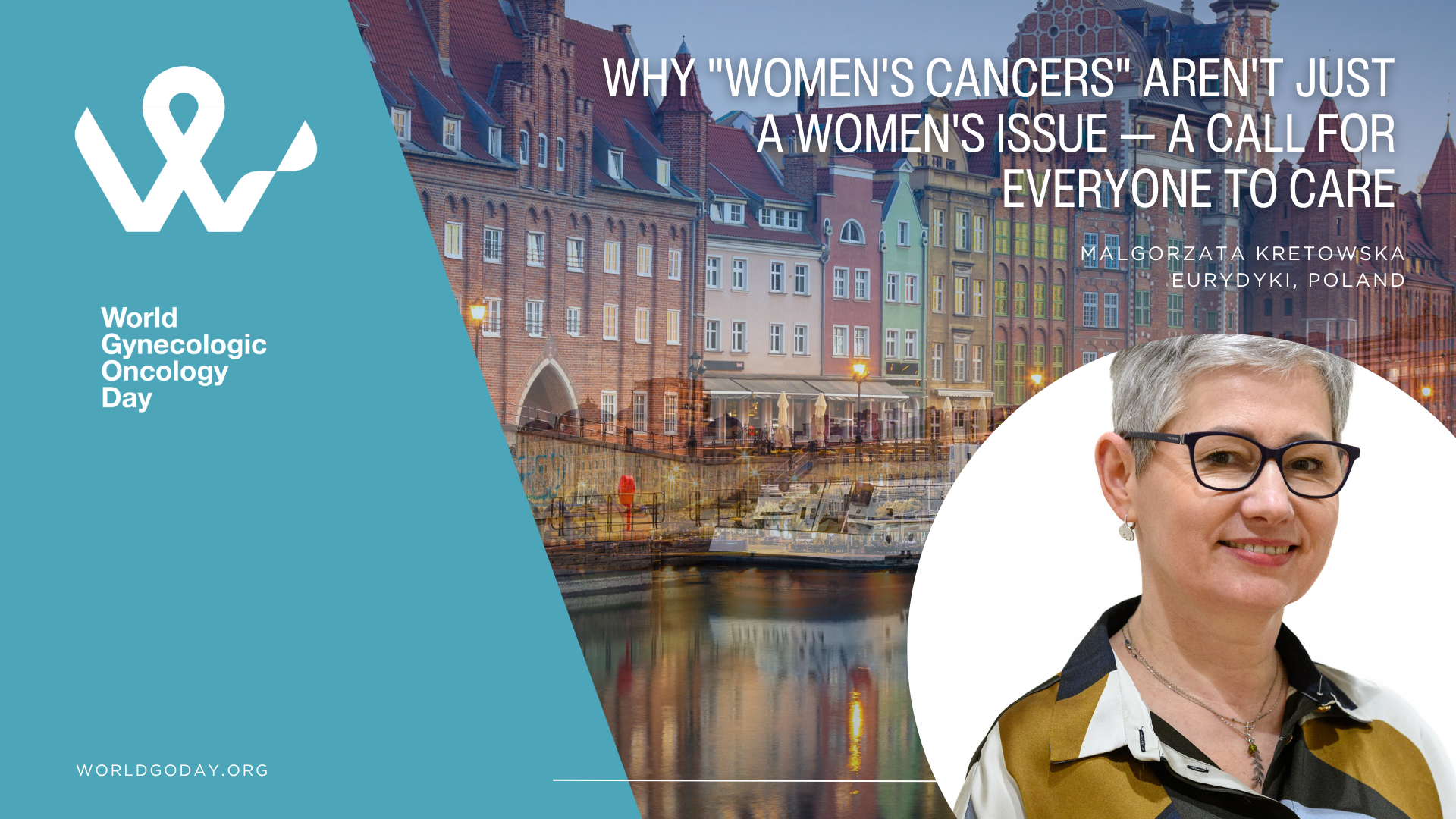
When "Women´s Cancers" Aren´t Just Women´s Issues - A Call for Everyone to Care
By Malgorzata Kretowska
EURYDYKI Patient Organization, Poland
Imagine a happy married couple with two children in the early years of primary school, who have finally moved into their new dream home. They look to the future with hope—almost certainty—that the hardest times are behind them and that at least a few peaceful years lie ahead. And then, suddenly, this idyllic picture is shattered into thousands of tiny pieces that, despite every effort, can never truly be put back together the way they were before.
Ovarian cancer—it was a shock, an earthquake, a tsunami. Something that forced its way into our lives uninvited and unwanted. It is a disease whose consequences we still feel today—nine years later.
I went to the hospital to have an ovarian cyst removed. The day before the surgery, after undergoing a CT scan, I was told that the cyst contained cancer and that there was also metastasis on my diaphragm. I was overwhelmed by an incredible sense of insecurity and the conviction that I could not carry this burden alone. I called my husband. Even from a distance, I could feel his emotions, dominated by fear and helplessness. As I later learned, he also needed to share the news with someone because he could not bear it on his own. He called his mother.
And this is how a disease that affects one person becomes the concern of many—loved ones, family members, friends, and acquaintances. Each of them must somehow find their place in this new reality. Of course, it is hardest on those closest to us. My husband had to confront his own fears and become the pillar of support for all of us. Alongside his professional responsibilities, he took on care for me after surgery and during chemotherapy, as well as care for our children—preparing breakfasts, doing laundry, helping with homework, and attending parent-teacher meetings. He managed, but I could see how difficult it was for him. In his eyes, I saw concern and a question that was never spoken aloud: “Will you survive?”
I did survive, but along the way, I met many women who did not. They left behind an empty space in the hearts of countless people, including children—often very young children—who must now go through life without their mother. Each of us is someone’s daughter, sister, friend, wife, mother, or partner. We are not alone.
When one of us falls ill, it sets off a chain of consequences—not only within families, where the impact is most deeply felt and most painful, but also among friends and in workplaces. That is why women’s cancers are not only a women’s issue. We should all deepen our knowledge of their symptoms and prevention.
This knowledge may save the life of your partner, daughter, or mother—because you remind her about regular check-ups, because you notice something concerning in her appearance, or because you recognize a symptom based on what you know about women’s cancers. Awareness in this area also helps parents make informed decisions about HPV vaccination for their children—it is a responsibility shared by both parents.
I wish that nine years ago someone had told me that an increasing abdominal circumference could be a sign of ovarian cancer. I wish someone had told me that the stories of the women in my family (many of whom had suffered from breast cancer) suggested that we might carry genetic mutations. No one around me was aware of it.
YOU SHOULD BE. A life may depend on it.