



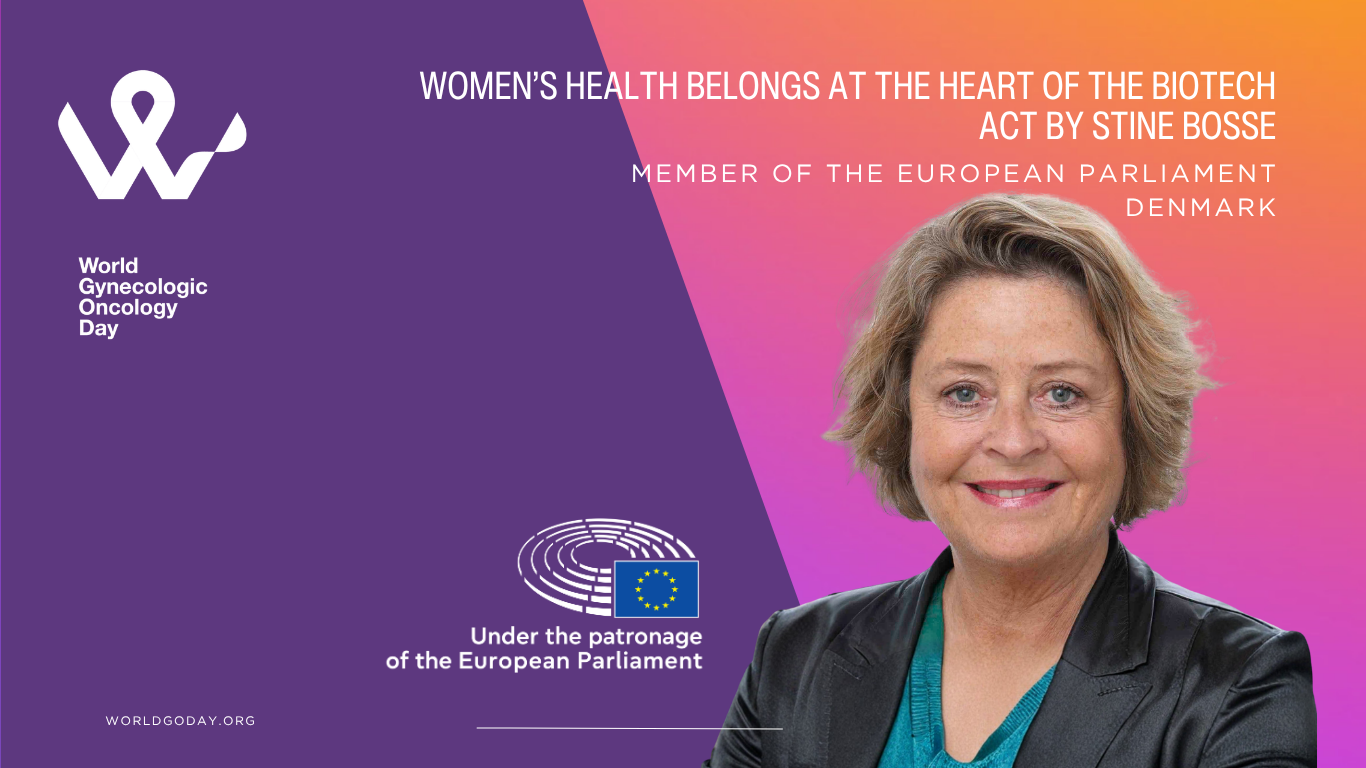
Women’s health belongs at the heart of the Biotech Act
MEP Stine Bosse
Vice-Chair of the Committee on Public Health
Women’s health is still falling behind
With an estimated 40,714 new cases of ovarian cancer diagnosed in the European Union and 27,677 deaths recorded in 2022, ovarian cancer remains the most lethal gynaecological cancer in Europe.1 This is largely attributed to late diagnoses and the absence of screening.
This is part of a wider problem. Women’s health remains under-prioritised, under-researched and under-funded. As a result, women with gynaecological cancers still face delayed diagnosis, unequal access to specialist care and clinical trials, and significant differences in outcomes between European countries.2
We have the science and the clinical expertise to do far more for women’s health.3 The EU retains substantial scientific strength in biotechnology, and wishes to invest further to be competitive at the global level.4 But scientific excellence alone is not enough: it must be used where it is needed most for the benefit of all. The upcoming Biotech Act is the right instrument to ensure this competitive drive serves women’s health needs.
Why the research gap persists
Until now, women’s health has not been prioritised in research.5 A 2025 study commissioned by the European Parliament found a critical lack of sex- and gender-disaggregated health data and continued underrepresentation of women in clinical research. It also found that, in 2020, only 5% of global R&D funding went to women’s health: 4% to women’s cancers and 1% to other women-specific conditions.6
In addition, the EU has been losing ground on clinical research more broadly due to global competition and a fragmented research ecosystem. The European Economic Area’s share of global commercially sponsored clinical trials fell from 22% in 2013 to 12% in 2023. Other countries are proving more attractive for research: the United States and China approve clinical trial applications within 60 days, while multinational trials in the EU take an average of 113 days.7 Furthermore, data and expertise tend to be spread across all EU Member States. This fragmentation, caused by multiple national systems, stands in the way of research, especially for the rare and low-prevalence tumours that affect European women.8
But Europe is not short of assets. The European Reference Networks (ERNs) provide an established structure for sharing highly specialised expertise, while the European Health Data Space (EHDS) establishes the framework for health data to be reused securely for research and innovation as its provisions are progressively implemented.9 The time has come now to connect these measures more deliberately around women’s health and use them at scale. The Biotech Act allows us to do so.
What the Biotech Act can provide
The Biotech Act is currently under negotiation in the European Parliament, and as Renew Europe's shadow rapporteur in the Public Health Committee I am directly involved in shaping our position.10 My stance is clear: we must foster a regulatory environment that empowers us to lead the biotech race. This would ensure that innovation in gynaecological cancers is developed, tested and scaled right here in Europe.
The Commission proposes to cut the authorisation timeline for multinational clinical trials from 106 to 75 days. It would also create a new category of high-impact health biotechnology strategic projects, including centres of excellence for advanced therapies, bringing together clinical centres, research organisations, industry, investors and regulators.11
We can go further. Rare diseases and rare cancers should be named as a priority in the criteria for those projects. And for multinational trials, one ethical assessment should stand for the whole Union.12
These ambitions cannot be realised without dedicated funding. The Parliament has already pushed to make women’s health one of its investment priorities in the European Competitiveness Fund.13 Now we need to ensure the Biotech Act follows the same logic and contributes towards women’s cancers being recognised as one of Europe’s strategic biotechnology priorities.
On 20 September, World Gynecologic Oncology Day will once again focus international attention on gynaecological cancers.14 Awareness matters, but this is also a moment for action. Europe can lead on women’s health. The Biotech Act gives us the opportunity to turn those strengths into better research, faster trials and improved outcomes for women.
Footnotes & References
1 https://ecis.jrc.ec.europa.eu/cancer-factsheets-eu-27-countries-2022(opens in new tab)
2 Urkmez E, Andac-Jones E, Cibula D, Querleu D, Halaska MJ, Driak D, et al. Perceptions, expectations, and experiences of gynecological cancer patients: a pan-European ESGO/ ENGAGe survey. International Journal of Gynecological Cancer. 2019 Nov;29(9):1425– 30.
Boitano TKL, Powell MA, Leath CA, Michael Straughn J, Scarinci IC. Barriers and facilitators affecting presentation in women with early versus advanced stage cervical cancer. Gynecol Oncol Rep. 2022 Apr; 40:100950.
Algera MD, Morton R, Sundar SS, Farrell R, van Driel WJ, Brennan D, et al. Exploring international differences in ovarian cancer care: a survey report on global patterns of care, current practices, and barriers. International Journal of Gynecological Cancer. 2023 Oct;33(10):1612–20.
3 European Commission, Proposal for a Regulation on establishing a framework of measures for strengthening Union's biotechnology and biomanufacturing sectors particularly in the area of health (European Biotech Act), COM(2025) 1022 final/2, Strasbourg, 16 December 2025, p. 1. https://eur-lex.europa.eu/legal-content/EN/TXT/HTML/?uri=CELEX:52025PC1022(01)(opens in new tab)
4 https://health.ec.europa.eu/biotechnology/overview_en(opens in new tab)
5 Inspired by June webinar https://www.linkedin.com/events/7473369812350717952/(opens in new tab)
6 Konstantina Davaki, Gender Inequalities in Medical Research, Drug Development and Access to Care, European Parliament, Policy Department for Citizens, Equality and Culture, PE 778.519, November 2025, especially pp. 23 and 57. Page 23 states that only 5% of global R&D funding in 2020 went to women’s health — 4% to women’s cancers and 1% to other women-specific conditions. Page 57 identifies a “critical lack” of sex- and gender-disaggregated epidemiological and clinical data and underrepresentation of women in trials.
7 European Commission, DG SANTE, “Health biotechnology in the EU – figures”, Biotechnology: Overview. This is the direct Commission source for both figures: EEA share of global commercial clinical trials declining from 22% in 2013 to 12% in 2023, and an average 113 days for EU multinational trial authorisation compared with within 60 days in the US and China.
8 ESGO, Closing the Gap in Women’s Health, 2026, pp. 6 and 9. Page 6 says trial participation is particularly low among women with rare tumour types. Page 9 gives the 12,000+ records / 86 centres / 26 countries figures and states that ENGOT coordinates pan-European phase II–III trials.
9 European Commission, “European Reference Networks” and European Commission, “European Health Data Space Regulation”. The Commission describes ERNs as cross-border networks for rare, low-prevalence and complex conditions; it lists EURACAN for rare adult solid cancers. EHDS establishes the health-data framework, but implementation is progressive.
11 European Commission, proposal for the European Biotech Act, COM(2025) 1022 final, 16 December 2025. The proposal explicitly says multinational clinical-trial authorisation would fall from 106 to 75 days, including validation and ethical review. Articles 4–6 establish “high impact health biotechnology strategic projects” and centres of excellence for advanced therapies, including cooperation between clinical centres, research organisations, industry, investors and regulators.
12 Stine Bosse, remarks on LinkedIn (https://www.linkedin.com/posts/stine-bosse-5654953a_speaking-at-the-parliament-rare-diseases-activity-7452336083645800449-2gJi/(opens in new tab)) the European Biotech Act / rare diseases, 2026. Bosse has publicly proposed a targeted “28th regime”, including a centralised or once-only European approach to ethics decisions for cross-border trials in rare diseases and rare cancers.
13 https://www.linkedin.com/posts/stine-bosse-5654953a_today-im-very-proud-of-the-achievements-activity-7457709149536124928-E5kg/(opens in new tab)
https://www.europarl.europa.eu/meps/en/257020/STINE_BOSSE/main-activities/opinions(opens in new tab)